
Agentic AI content marketing has moved from prototype to production: autonomous AI agents are now researching competitors, generating briefs, writing and editing long-form copy, scheduling social posts, and reporting on performance—without a human touching each step. The shift is less about smarter writing tools and more about a fundamentally different operating model, where content pipelines run continuously at a scale no human team could match. If you haven't mapped how autonomous agents fit into your content strategy, your competitors may already be lapping you.
What Agentic AI Content Marketing Actually Means in 2026
The term "agentic AI" gets used loosely, so it's worth pinning down precisely what it means in a content context. An AI agent is a system that perceives its environment, sets sub-goals, takes sequential actions, and adjusts its behavior based on feedback—all to accomplish a higher-level objective set by a human. The distinction from standard generative AI tools like a basic ChatGPT prompt is significant: a single prompt produces a single output. An agent runs a loop, calling tools, checking results, and deciding what to do next.
In content marketing, this translates to agents that can receive a goal—say, "publish three SEO-optimized blog posts per week targeting mid-funnel keywords in the cybersecurity space"—and independently handle the workflow end to end. That workflow typically includes SERP analysis and keyword clustering, competitor content auditing, brief generation, draft writing, internal linking, image sourcing, CMS publishing, and social distribution. Each of those steps would normally consume hours of human time. An agent completes the sequence in minutes, iterating until defined quality thresholds are met.
"By 2026, industry projections suggest that more than 80% of enterprises will have deployed agentic AI in at least one business function—up from under 15% in 2024—with marketing and content operations consistently ranking among the top three use cases."
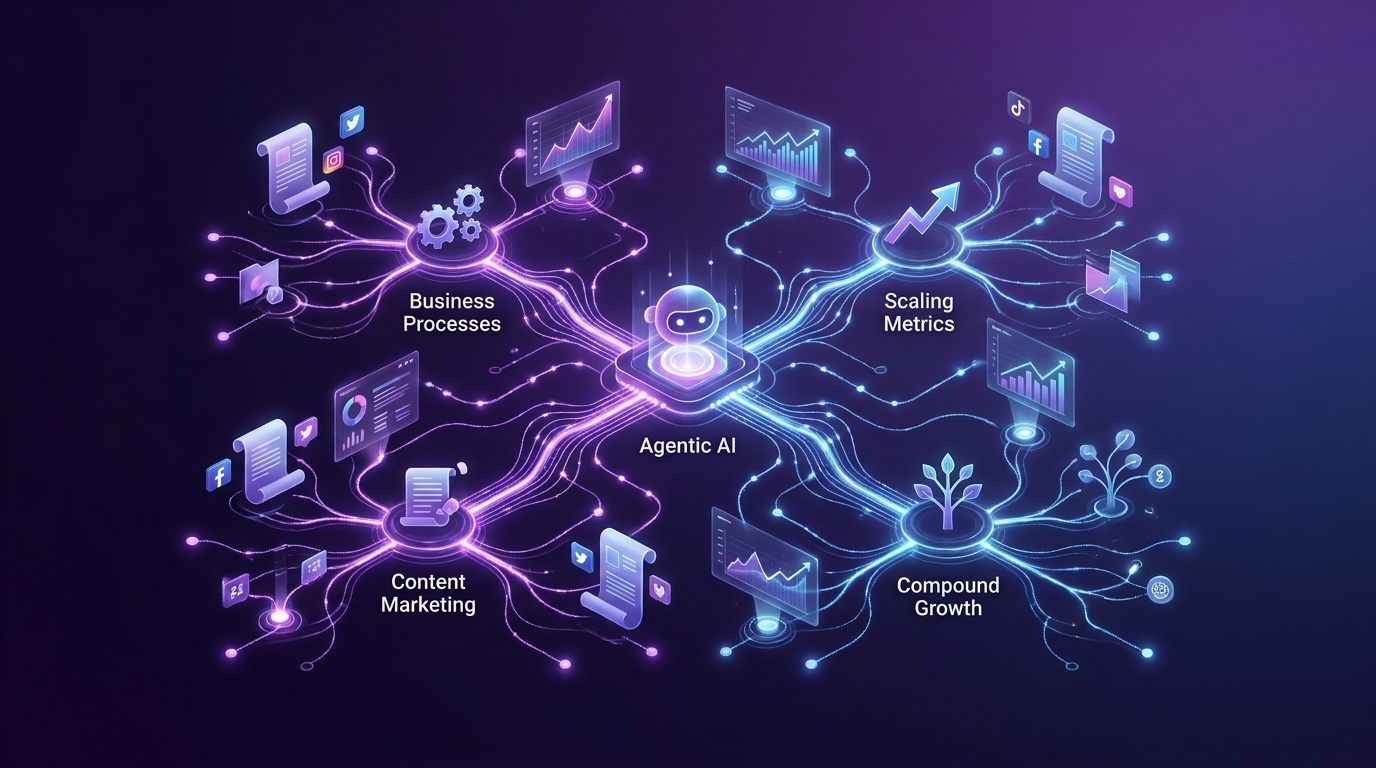
The architecture enabling this matters because it explains the pace of adoption. Modern agent frameworks—LangGraph, AutoGen, CrewAI, and vendor-native systems from platforms like HubSpot and Salesforce—make it dramatically easier to chain specialized sub-agents. A research agent hands a synthesized brief to a writing agent, which passes a draft to an editing agent, which triggers a distribution agent. Each sub-agent is optimized for its narrow task and can call external tools: search APIs, analytics dashboards, stock image libraries, or social media schedulers. The result is a content factory that runs on orchestration logic rather than human coordination.
It's also worth understanding what agentic content systems are not. They aren't fully autonomous replacements for editorial judgment. The most effective deployments in 2026 use a human-in-the-loop model where a strategist sets the campaign parameters, approves brand guidelines, and reviews a sample of outputs. The agent handles execution volume; humans maintain quality control and creative direction. That boundary is where most smart organizations are drawing the line right now. For a broader view of how this autonomous shift is playing out across every marketing channel, see our guide on agentic AI for digital marketing.
How Autonomous Agents Are Changing Content Roles and Workflows
The organizational impact of agentic content systems isn't uniform—it reshapes roles differently depending on team size, content volume requirements, and the maturity of existing tech stacks. Understanding these patterns helps content leaders make better resourcing decisions rather than reacting to hype.
Content strategists are moving up the value chain. Because agents can handle brief creation and keyword research, strategists spend more time on audience modeling, narrative architecture, and competitive positioning—the conceptual work that requires genuine market intuition. Teams that previously had one strategist managing three writers are seeing that strategist effectively manage ten agent-assisted workflows simultaneously.
Content writers and editors face the most significant role evolution. The volume of "commodity" content—product descriptions, FAQ pages, location pages, boilerplate category copy—is increasingly handled by agents without writer involvement. Writers who thrive in agentic environments tend to focus on thought leadership, interview-driven features, and complex explainers where firsthand expertise and original reporting remain irreplaceable. Editing roles are shifting toward prompt engineering and output evaluation: reviewing agent-produced drafts for accuracy, brand voice, and factual integrity rather than writing from scratch.
SEO and distribution specialists are finding their workflows dramatically compressed. An agent can perform a full technical content audit, identify topical gaps, generate a six-month content calendar, and push it to a project management system in roughly the time it used to take to run a single keyword research session manually.
| Content Function | Traditional Workflow Time | Agentic Workflow Time | Human Role Remaining |
|---|---|---|---|
| Keyword research & clustering | 3–6 hours | 8–15 minutes | Approval and prioritization |
| Content brief creation | 1–2 hours per brief | 2–5 minutes per brief | Brand voice review |
| First draft (1,500-word post) | 2–4 hours | 3–7 minutes | Fact-check, insight addition |
| Social distribution (5 platforms) | 45–90 minutes | Automated on publish | Exception handling |
| Monthly performance reporting | 4–8 hours | 30–60 minutes | Strategic interpretation |
For small and mid-sized businesses, the leverage effect is especially pronounced. A three-person marketing team using agentic content systems can realistically produce and distribute the content volume that previously required a ten-person department. That isn't a theoretical ceiling—it's the operational reality reported by early adopters in B2B SaaS, e-commerce, and professional services through 2024 and into 2026. Enterprise teams, meanwhile, are using agents to enable personalization at scale that was previously impossible: dynamically generating industry-specific variants of the same core content asset and distributing each variant to the appropriate audience segment automatically.
The Evidence: Data Points That Show the Scale of Adoption
Skepticism about AI adoption statistics is healthy—vendor surveys notoriously skew toward enthusiasm. But the signals around agentic content marketing adoption are consistent enough across independent sources to paint a clear picture of where things actually stand heading into the second half of 2026.
According to Salesforce's State of Marketing report, 68% of marketing leaders say they are either currently using or actively piloting AI agents in their content workflows, up from 31% in 2023. More telling is that 41% of that group report content production volume has increased by more than 200% since deploying agents—without proportionate headcount growth. McKinsey's 2024 Technology Trends report identified marketing content automation as one of the five fastest-deploying enterprise AI use cases, noting that time-to-value in content operations was measurably shorter than in functions like supply chain or finance.
On the organic search side, the impact is becoming visible in SERPs. An analysis of 500 high-volume keywords across B2B sectors conducted by Semrush in late 2024 found that pages produced with AI-assisted or agent-driven workflows accounted for 34% of first-page results—but critically, the top-ranking pages in that set were distinguished not by volume but by depth of original insight and proper E-E-A-T signals. This reinforces the thesis that agentic systems win on efficiency, but human expertise layered on top wins on rankings.
Distribution metrics tell a parallel story. HubSpot's internal benchmark data from enterprise customers using its AI agent features showed that agent-managed social distribution led to a 28% increase in content-driven pipeline compared to manually scheduled posts, primarily because agents consistently optimized post timing, format, and platform-specific copy rather than reusing one-size-fits-all captions. The compounding effect of high-frequency, well-optimized distribution is something human teams structurally struggle to maintain over time—agents do not get fatigued or inconsistent.
Cost economics are shifting, too. Early adopters report content cost-per-piece falling by 40–70% once agentic workflows reach steady state, though the upfront investment in system design, tool integration, and quality calibration is real and should not be underestimated. Organizations that treat agent deployment as a "plug and play" event without redesigning their content governance model tend to produce high volume but low-quality output—and then attribute the failure to AI rather than to poor implementation.
For a comprehensive framework covering how these agentic capabilities integrate across your full marketing stack—not just content—the agentic AI marketing guide provides the strategic context that makes individual use cases make more sense.
What to Do Right Now—and What's Coming Next
The organizations extracting the most value from agentic content systems in 2026 share a consistent set of behaviors. They didn't wait for perfect tools. They started with a narrow, high-volume content task—typically programmatic SEO pages or social content repurposing—proved ROI in a contained environment, then expanded scope. Here's the practical roadmap that pattern suggests.
Audit your content workflow for repetition density. Tasks that require the same judgment repeatedly at volume are your best starting candidates for agent automation. FAQ pages, product descriptions, boilerplate landing page variants, and social adaptations of existing long-form content all fit this profile. Map the inputs and outputs of those tasks precisely before touching any tooling.
Choose an orchestration layer that fits your stack. If your team lives in HubSpot or Salesforce, their native AI agent features create the lowest integration friction. If you need custom workflows, frameworks like LangGraph or CrewAI give you more flexibility at the cost of engineering overhead. Do not build custom orchestration if a platform tool does 80% of what you need—the maintenance burden is underestimated by almost every team that goes down that path.
Define your quality thresholds explicitly before deployment. Agents optimize toward whatever signals you give them. If you don't specify that factual accuracy matters more than keyword density, the agent doesn't know. Build evaluation criteria—brand voice compliance, factual claim verifiability, internal linking logic—into the agent's system prompt and output review stage.
Run a pilot with a clear measurement window. Four to six weeks is enough to measure content velocity, output quality error rate, and downstream traffic impact on pilot content. Set a baseline from your pre-agent workflow and compare directly. This evidence base is what gets broader organizational buy-in and budget allocation.
Looking ahead to late 2026 and 2026, three developments are worth watching. First, multimodal content agents—capable of planning, writing, and generating visual assets within a single workflow—are moving from labs to commercial availability. Second, real-time personalization agents that adjust content dynamically based on individual user behavior signals (not just segment rules) are being rolled out by enterprise CMS platforms. Third, and most significant for search marketers, AI-native search engines like Perplexity and Google's AI Overviews are changing what "ranking" means: structured, citation-ready content designed for machine consumption is increasingly as important as content designed for human reading. Agentic content systems that can produce both formats simultaneously will define the next competitive frontier.
Frequently Asked Questions
What is agentic AI in content marketing?
Agentic AI in content marketing refers to autonomous AI systems that can execute multi-step content workflows—researching topics, writing drafts, optimizing for SEO, publishing to a CMS, and distributing across channels—without requiring a human to manage each individual step. Unlike basic AI writing tools that respond to a single prompt, agents operate in loops, use external tools, and make sequential decisions to complete a defined content goal. Human oversight remains important for quality control, brand consistency, and strategic direction.
Will agentic AI replace content writers and marketers?
Agentic AI is replacing specific tasks within content roles—particularly high-volume, repetitive production work like product descriptions, FAQ pages, and social media adaptations—rather than eliminating content professionals wholesale. Writers who focus on original research, expert insight, interviews, and complex strategic narratives remain essential because those outputs require firsthand knowledge that agents cannot fabricate reliably. The most accurate frame is role evolution: content professionals are shifting from production execution to creative direction, quality evaluation, and strategic oversight of agent-driven workflows.
Does Google penalize AI-generated content from autonomous agents?
Google's stated position is that it evaluates content based on quality, helpfulness, and E-E-A-T signals (Experience, Expertise, Authoritativeness, Trustworthiness) regardless of how it was produced. Content that is thin, repetitive, or demonstrates no original expertise can be penalized regardless of whether it was written by a human or an agent. The practical implication is that agent-produced content needs human-added expertise signals—firsthand observations, original data, authoritative citations—to rank competitively in contested SERPs.
What are the best tools for implementing agentic AI content marketing in 2026?
The leading options in 2026 depend on your team's technical capacity. For low-code or no-code environments, HubSpot's Breeze AI agents, Salesforce Agentforce, and Jasper's AI workflows offer content-specific agent capabilities with CRM integration. For teams comfortable with code, LangGraph and CrewAI provide flexible orchestration frameworks that can connect to any content tool via API. Platforms like Surfer SEO, Frase, and MarketMuse are adding agent-layer features that automate the brief-to-publish pipeline specifically for SEO-focused content teams.