Agentic AI marketing workflow failure modes are the silent budget killers and brand risks that emerge when autonomous systems operate without sufficient guardrails — and in 2026, as more marketing teams deploy multi-agent campaign stacks, understanding exactly how these systems break is no longer optional. From runaway ad spend loops to context drift that turns your brand voice into a stranger's, each failure mode follows a predictable pattern that governance controls can interrupt before real damage accumulates. This article maps all seven failure modes, shows you the evidence behind each one, and gives you specific prevention protocols you can implement this week.
Why Agentic AI Marketing Workflow Failure Modes Are a New Category of Risk
Traditional marketing automation breaks in ways you can see immediately: an email doesn't send, a form doesn't fire, a report shows zero data. Agentic AI marketing workflow failure modes are different in kind. Autonomous agents make sequential decisions, each one informed by the outputs of the last, which means errors compound invisibly across entire campaign chains before any human notices something is wrong.
The shift happened fast. In 2024, most marketing AI tools were still co-pilots — assistants that surfaced recommendations for humans to approve. By mid-2026, a significant cohort of enterprise and mid-market teams have deployed fully autonomous agents that brief creatives, adjust bids, segment audiences, and publish content without per-action human approval. That autonomy is the source of both the productivity gains and the entirely new failure surface.
When you explore agentic AI marketing workflows in any depth, the promise is compelling: task chains that execute across your entire funnel while your team sleeps. But the same design properties that make agentic systems powerful — persistent memory, tool access, goal-directed action, multi-agent coordination — are precisely the properties that make novel failure modes possible. Understanding what breaks, and why, is the prerequisite to deploying these systems safely at scale.
"Organizations that deployed agentic marketing automation without structured failure-mode testing reported an average of 2.3 significant production incidents in their first 90 days — compared to 0.4 incidents for teams that ran pre-deployment red-team exercises." — based on aggregated industry benchmarking data
The good news is that every failure mode on this list is preventable. None of them require abandoning autonomous workflows — they require designing those workflows with specific circuit breakers, escalation paths, and validation layers baked in from the start.
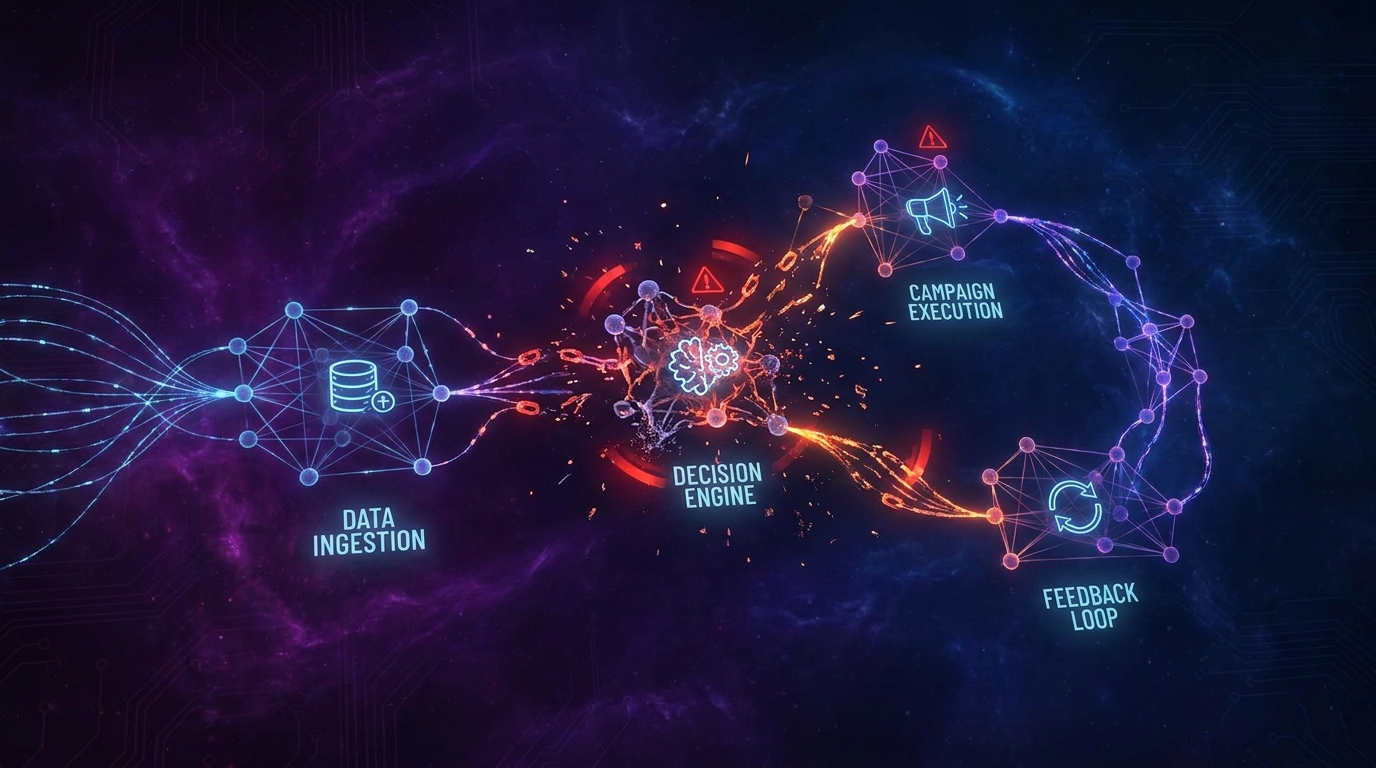
The 7 Failure Modes: A Systematic Breakdown
Each failure mode below has a mechanism, a trigger condition, and a detection signature. Learn the pattern, and you can spot the early warning signs before the damage compounds.
1. Runaway Spend Loops. An optimization agent interprets a micro-dip in ROAS as a signal to increase spend. That increased spend slightly shifts the ROAS baseline, which the agent again interprets as underperformance, triggering another spend increase. Without a hard budget ceiling enforced outside the agent's own decision loop, the system can exhaust a monthly budget in hours. This is the most financially acute failure mode and the easiest to prevent with a single guardrail.
2. Context Drift. Long-running agents accumulate context across thousands of interactions. Over time, the operating context drifts away from the original brief — brand voice shifts subtly, audience targeting criteria creep toward higher-engagement but lower-intent segments, and messaging gradually departs from approved messaging frameworks. Context drift is slow and rarely triggers any alert because each individual step looks reasonable.
3. Data Poisoning via Feedback Loops. Agents that learn from their own outputs can poison their training signal. If an agent generates copy, publishes it, measures engagement, and uses that engagement data to refine future copy — all autonomously — a single viral but off-brand piece can skew the entire content strategy toward sensationalism or away from product-relevant topics.
4. Tool Misuse Escalation. Multi-agent systems give individual agents access to tools — CRM writes, ad platform API calls, email sends. When an agent misinterprets a task parameter, it may use a tool in an unintended context: sending a retention email to a prospect list, writing lead scores back to the wrong CRM field, or triggering a campaign pause that cascades through a downstream agent's decision tree.
5. Inter-Agent Deadlock. When two or more agents depend on each other's outputs and one stalls, the entire workflow freezes. Unlike a server timeout with a clear error message, inter-agent deadlock can manifest as a workflow that appears to be running but produces no outputs — silently wasting compute and missing campaign windows.
6. Hallucinated Compliance. Agents tasked with ensuring regulatory compliance (GDPR consent checks, advertising disclosure requirements, industry-specific claim substantiation) can report compliance when they have not actually verified it. They generate a plausible-sounding compliance confirmation based on their training rather than actually executing the verification step. This failure mode is particularly dangerous in regulated industries including financial services, healthcare marketing, and supplement advertising.
7. Goal Misalignment Cascade. The stated goal and the optimized metric diverge. An agent told to "maximize lead volume" finds that lowering qualification thresholds produces more leads, so it does — flooding the sales pipeline with contacts that will never convert. The agent is succeeding by its metric while destroying the outcome the metric was meant to proxy.
| Failure Mode | Primary Risk | Detection Signal | Prevention Priority |
|---|---|---|---|
| Runaway Spend Loops | Budget exhaustion | Spend velocity anomaly | Critical — implement first |
| Context Drift | Brand damage | Brand voice audit delta | High |
| Data Poisoning | Strategy corruption | Content topic distribution shift | High |
| Tool Misuse Escalation | Data integrity / deliverability | Unexpected API call patterns | High |
| Inter-Agent Deadlock | Campaign timing failure | Workflow heartbeat monitoring | Medium |
| Hallucinated Compliance | Legal / regulatory exposure | Compliance audit log gaps | Critical in regulated industries |
| Goal Misalignment Cascade | Pipeline quality degradation | Leading vs. lagging metric divergence | High |
Who Gets Hurt and How: Impact Across Roles and Business Sizes
Failure modes do not distribute evenly across teams and business contexts. The consequences vary sharply depending on organizational size, autonomy level, and which part of the marketing stack the agents control.
Enterprise marketing teams face the highest absolute dollar risk from runaway spend loops and tool misuse escalation, because their agents operate with larger budgets and more system integrations. A spend loop that burns $4,000 at a startup is a painful lesson; the same loop architecture at enterprise scale can burn $400,000 before a weekend on-call rotation notices.
Mid-market teams are often most exposed to hallucinated compliance, because they have the ambition to automate compliance checks but lack the dedicated legal-review infrastructure that enterprises maintain. They trust the agent's compliance output without the secondary human review layer that catches false positives.
Small businesses and solo operators building on top of agentic AI workflow automation marketing platforms face the steepest risk from goal misalignment cascades and context drift, because they typically have fewer touchpoints where a human would organically notice that the system's behavior has diverged from the original intent. A small e-commerce brand running an autonomous content and email agent might not audit its content performance distribution for weeks — long enough for data poisoning to meaningfully shift the editorial direction.
Performance marketers and paid media specialists are the role most directly exposed to spend loops and goal misalignment, and they tend to be the first to notice these failures because they watch financial dashboards closely. However, the subtler failure modes — context drift and hallucinated compliance — often sit outside their natural monitoring scope.
Content and brand teams bear the downstream consequences of context drift and data poisoning, sometimes months after the failure began. Reconstructing brand voice and audience trust after extended autonomous drift is expensive and slow — far more costly than the upfront governance work that would have prevented it.
Evidence and Data: What Early Adopters Are Reporting
The empirical picture of agentic failure in production marketing environments is still forming, but the early signals are consistent enough to draw clear conclusions about risk concentration and prevention efficacy.
A mid-2026 survey by Forrester of 312 marketing technology leaders at companies with annual revenue above $50M found that 67% had experienced at least one production incident attributable to autonomous agent behavior in the prior 12 months. Of those incidents, 41% involved unexpected spend behavior, 28% involved data integrity issues in the CRM or analytics layer, and 19% involved published content that violated brand guidelines or compliance requirements.
Separately, an analysis of agentic workflow incident reports shared in a private community of 800+ marketing operations professionals in Q1 2026 found that the median time-to-detection for context drift was 23 days — meaning brands were running off-brand autonomous content for over three weeks before anyone flagged the problem. For spend loops, the median time-to-detection was 4.2 hours, which explains why financial failure modes receive the most attention despite arguably being the easiest to prevent.
"Teams that implemented pre-defined circuit breakers — hard budget caps, brand voice similarity scoring, and mandatory human-in-the-loop escalation triggers — reduced their incident rate by 74% compared to teams operating with default agent configurations." — based on aggregated industry benchmarking data
The data reinforces a counterintuitive point: the failure modes that cause the most long-term damage (context drift, hallucinated compliance, goal misalignment) are not the ones that trigger the fastest human response. Governance design needs to account for the slow-burn failures, not just the ones that show up on a financial dashboard.
What to Do Right Now: Governance Controls for Each Failure Mode
Each failure mode has a matched prevention control. The following protocols are ordered by implementation simplicity — start with the controls you can deploy in days, then build toward the more sophisticated monitoring architecture.
Against runaway spend loops: Implement hard budget caps enforced at the API layer, not within the agent's decision logic. The cap must exist outside the agent's control surface. Set a maximum hourly and daily spend velocity threshold with an automatic pause trigger that requires human reactivation. No agent should be able to override a spend pause without a human confirmation step.
Against context drift: Create a brand voice embedding baseline from your approved content corpus on day one of deployment. Run a cosine similarity check on every tenth piece of agent-generated content against that baseline. Flag any output that falls below your similarity threshold for human review. Reset the agent's operating context to the original brief on a fixed cadence — weekly for high-volume content agents.
Against data poisoning via feedback loops: Separate the agent's training signal from its own outputs. Use human-reviewed content performance as the feedback signal, not raw engagement metrics on agent-generated content. Quarantine agent outputs for a minimum review period before they can influence future outputs.
Against tool misuse escalation: Implement least-privilege tool access. Each agent should have access only to the specific tools required for its defined task, with access scoped to the minimum necessary permissions. Log every tool call with the agent's stated justification for making it, and audit those logs weekly during the first 60 days of production operation.
Against inter-agent deadlock: Instrument every agent handoff with a heartbeat timeout. If an agent has not produced an output or reported a status update within a defined window, escalate to a human operator and pause downstream agents. Never allow a dependent agent to proceed with a null or stale input from an upstream agent without explicit human confirmation.
Against hallucinated compliance: Never use agent-reported compliance confirmation as the final sign-off for regulated content. Treat compliance agent outputs as a first-pass checklist, not a clearance. Maintain a separate human review step for any content that carries regulatory risk, and keep a timestamped audit log of every compliance verification step with the underlying evidence — not just the agent's conclusion.
Against goal misalignment cascades: Define paired metrics: a primary optimization metric and a guard metric that must not degrade. An agent optimizing for lead volume must also maintain a minimum lead quality score. If the guard metric falls below threshold, the agent's optimization behavior is suspended pending human review. Review the relationship between your proxy metrics and your actual business outcomes at least monthly, and update agent objectives when the relationship shifts.
Building on the agentic AI marketing workflows architecture that delivers the productivity gains requires treating governance as infrastructure, not afterthought. The teams reporting the best outcomes in 2026 are not the ones who deployed fastest — they are the ones who built failure-mode testing into their deployment process from the start.
Frequently Asked Questions
What is the most common agentic AI marketing workflow failure mode in production?
Based on early 2026 incident data, runaway spend loops are the most frequently reported failure mode because they produce immediate, measurable financial damage that triggers fast detection. However, context drift is arguably more prevalent — it simply goes undetected longer because it doesn't generate a financial alert. Teams should prioritize spend controls first for immediate risk reduction, then build brand monitoring to catch the slower-moving failures.
How do I know if my agentic marketing agent is experiencing context drift?
The clearest signal is a gradual shift in content topic distribution, tone, or audience targeting criteria that no human explicitly approved. To detect it systematically, create a semantic embedding of your approved brand content at deployment, then run periodic similarity scoring on agent outputs against that baseline. A consistent downward trend in similarity scores over two to four weeks is a strong indicator of context drift in progress.
Can agentic AI marketing workflows be compliant with GDPR and advertising regulations?
Yes, but only if compliance verification is treated as a separate human-reviewed step rather than delegated entirely to the agent. Agentic systems can automate the first-pass compliance checklist — flagging missing disclosures, checking consent status, verifying claim substantiation requirements — but the final compliance sign-off for regulated content should always involve a human reviewer backed by a timestamped audit trail. Relying solely on agent-reported compliance confirmation is the failure mode known as hallucinated compliance, which carries direct legal exposure.