
The debate around agentic AI vs marketing automation isn't just semantic — it represents a fundamental shift in how marketing systems make decisions, execute campaigns, and adapt to customer behavior. Traditional automation follows the rules you write; agentic AI writes its own playbook in real time. Understanding the difference determines whether your 2026 marketing stack is a competitive advantage or an expensive legacy system.
How Agentic AI and Marketing Automation Actually Differ
Marketing automation and agentic AI share a surface-level resemblance: both handle repetitive marketing tasks without manual intervention. But the architecture underneath — and the outcomes on top — are fundamentally different in ways that matter deeply for marketing leaders planning their next investment.
Traditional marketing automation platforms like HubSpot, Marketo, and Pardot operate on a trigger-action logic. A contact fills out a form → they enter a nurture sequence → after five days they receive email three. Every branch of that decision tree was defined by a human being, tested by a human being, and approved by a human being. The system executes flawlessly within those boundaries, but it cannot reason beyond them.
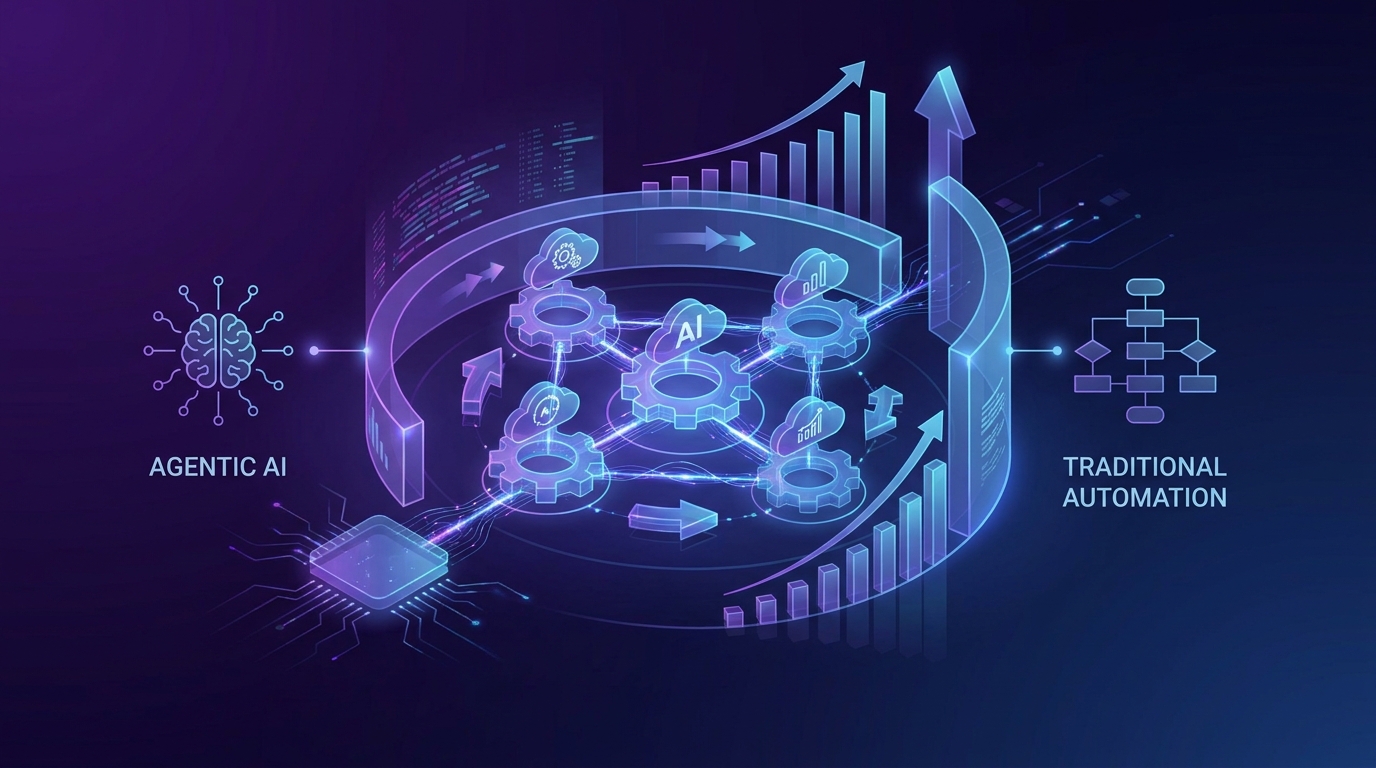
Agentic AI systems — the architecture explored in depth across the emerging field of agentic AI marketing — operate on a fundamentally different principle. Rather than following pre-defined workflows, these systems perceive their environment, set sub-goals, take actions, evaluate outcomes, and adjust their approach — all without a human scripting each step. They behave more like autonomous employees than automated assembly lines.
"By 2026, industry projections suggest that over 80% of enterprises will have deployed some form of agentic AI, up from fewer than 1% in 2024 — and marketing is one of the fastest-moving functions in that transition."
The practical consequence of this architectural difference is enormous. Marketing automation scales effort: it lets one marketer do the work of ten by automating the execution of decisions already made. Agentic AI scales intelligence: it lets systems make new decisions, test new hypotheses, and pursue new opportunities without waiting for human direction. Both capabilities are valuable, but they serve different problems and require different organizational readiness to deploy effectively.
What Traditional Marketing Automation Does Well
Before writing off traditional automation as obsolete, it's worth being precise about where it genuinely excels. Marketing automation platforms have spent two decades becoming extraordinarily reliable at a specific class of problem: executing known, repeatable processes at scale without human error.
Lead nurture sequences are the canonical example. When a B2B company knows that a prospect who downloads a whitepaper typically needs three educational emails before they're ready for a demo request, automation delivers that sequence with perfect consistency across thousands of contacts simultaneously. The logic is already validated; the platform just runs it without fatigue or distraction.
Automation also shines in compliance-sensitive environments. When your email sends need to respect suppression lists, honor unsubscribe requests within precise windows, and maintain GDPR-compliant consent records, a rules-based system with auditable logic is far safer than an AI that might find creative interpretations of its instructions. Regulated industries — financial services, healthcare, legal — often need to explain exactly why a contact received a particular message, and traditional automation provides that audit trail cleanly.
The technology is also mature, well-understood, and deeply integrated. Most CRM platforms offer native automation builders. Operations teams know how to build, test, and troubleshoot workflows. The vendor ecosystem for connectors, templates, and best practices is enormous. If you need to automate a straightforward lifecycle process and your team already uses Salesforce or HubSpot, there is no business case for introducing an entirely new AI layer to solve a problem that a well-configured workflow solves perfectly well.
"Companies using mature marketing automation report average revenue increases of 10–15% and cost reductions of 12–15% on campaign execution — gains that are real, proven, and not dependent on AI adoption."
The honest limitation is that automation's ceiling is your own knowledge. You can only automate what you already know to do. You cannot automate discovery, novel strategy, or responses to situations you didn't anticipate when you built the workflow.
What Agentic AI Brings to the Table
Agentic AI systems don't just execute tasks faster — they perceive goals, decompose them into sub-tasks, use tools to take action, and iterate based on results. In a marketing context, this means an agent might be given the objective "increase qualified pipeline from the enterprise segment by 20% this quarter" and then independently determine which channels to prioritize, what messaging to test, which accounts to target, and when to escalate anomalies to a human.
The core technical distinction is the presence of a reasoning loop. While automation says "if X then Y," an agentic system says "here is my current state, here is my goal, here are the tools available to me, let me decide what to do next." This loop — often described as a Perceive → Plan → Act → Reflect cycle — enables behaviors that rule-based systems simply cannot produce: hypothesis generation, multi-step problem solving across multiple data sources, and genuine adaptation to novel situations.
Practically, this unlocks several capabilities that represent real competitive differentiation. Agentic systems can run continuous multivariate experiments across channels without waiting for a human to analyze results and update settings. They can monitor intent signals across dozens of data sources and initiate outreach at the right moment without a workflow specifically built for that scenario. They can draft personalized content variants at the individual level, not just the segment level, because they can synthesize CRM data, behavioral signals, and contextual information in real time.
The architecture behind effective autonomous marketing systems typically includes an orchestration layer, specialized sub-agents for specific channels or functions, memory systems that maintain context across sessions, and tool integrations that allow agents to actually take action — sending emails, updating CRM records, adjusting ad bids, or firing webhooks to external systems.
"Early enterprise deployments of agentic marketing systems report 40–60% reductions in time-to-campaign and measurable improvements in conversion rates from AI-driven personalization that outpaces what human-designed segments can achieve."
The tradeoffs are real. Agentic systems require more sophisticated oversight frameworks, produce less predictable behavior, and introduce new risks around brand consistency, compliance, and rogue actions. They also require better data infrastructure than automation does — garbage in produces confidently wrong decisions at scale. The capability ceiling is much higher, but so is the implementation complexity.
Head-to-Head Comparison: Six Critical Dimensions
The differences between these two approaches become clearest when examined across the dimensions that matter most to marketing and technology leaders making stack decisions. The table below uses criteria relevant to real deployment decisions, not just technical abstractions.
| Dimension | Traditional Marketing Automation | Agentic AI |
|---|---|---|
| Decision-Making Model | Rule-based; deterministic. Executes pre-defined logic exactly as written. | Goal-oriented; probabilistic. Reasons toward an objective using available context and tools. |
| Adaptability | Low. Requires human to identify gaps and update workflows manually. | High. Adjusts strategies in real time based on observed outcomes and environmental changes. |
| Personalization Ceiling | Segment-level. Personalizes based on pre-defined audience attributes and list membership. | Individual-level. Synthesizes behavioral, contextual, and historical signals per contact in real time. |
| Implementation Complexity | Moderate. Well-understood tooling, large talent pool, established best practices. | High. Requires agent architecture design, prompt engineering, oversight systems, and data infrastructure. |
| Compliance & Auditability | Strong. Every action traceable to a specific rule or workflow node. | Developing. Requires explicit guardrails, logging, and human-in-the-loop checkpoints to maintain auditability. |
| Best Fit Use Cases | Lead nurture sequences, lifecycle emails, CRM data hygiene, event-triggered alerts, compliance workflows. | Dynamic campaign optimization, AI-driven prospecting, autonomous content creation, cross-channel orchestration, real-time offer personalization. |
One dimension absent from this table deserves explicit mention: cost structure. Marketing automation platforms typically charge based on contact database size or email volume, making costs predictable and scalable. Agentic AI systems currently involve LLM inference costs, orchestration infrastructure, and significant engineering investment — costs that are falling but still require careful ROI modeling, especially for teams with databases under 50,000 contacts where the automation ceiling hasn't yet been reached.
Which Approach Is Right for Your Business?
The framing of this as a binary choice is ultimately a false one — most mature marketing organizations will operate both in parallel. But for teams making prioritization decisions with limited budgets and bandwidth, the answer depends on where you currently sit and what your biggest constraint actually is.
If your marketing automation is immature, inconsistent, or underutilized, investing in agentic AI is premature. An autonomous system that surfaces brilliant opportunities is useless if your CRM data is unreliable, your email infrastructure lacks proper authentication, or your team lacks the operational discipline to act on signals quickly. Before any AI layer adds value, the foundation needs to be solid. Fix the plumbing first.
If your automation is mature and you're hitting the ceiling — you've built every workflow that makes sense, your nurture sequences are optimized, and incremental gains require disproportionate effort — that's the signal that agentic AI can unlock the next tier of performance. Teams in this position typically struggle with personalization at scale, cross-channel coordination, and the volume of decisions required to optimize campaigns in real time. These are exactly the problems agentic systems are built to solve.
Company stage also matters. For growth-stage companies with high experimentation velocity and dynamic ICPs, agentic AI's ability to test and adapt without waiting for human intervention is a genuine competitive weapon. For enterprise companies in regulated industries, the compliance and auditability gaps in current agentic systems may make full autonomy inappropriate — though hybrid architectures where agents draft and humans approve can bridge that gap effectively.
"The companies that will win in the next three years aren't replacing automation with AI — they're using automation to handle what's known and agentic AI to discover what isn't."
A useful heuristic: if you can write down all the rules your system needs to follow, automation is sufficient. If the ideal behavior requires judgment calls that depend on context you can't fully anticipate in advance, that's where agentic AI earns its investment.
How to Transition Your Stack Without Breaking What Works
The operational risk in any stack transition is disrupting what already works while building toward what might work better. The good news is that agentic AI doesn't require ripping out your automation platform — it requires inserting an intelligence layer on top of, or alongside, existing systems.
The most effective transition path follows a three-phase approach that moves from observation to assistance to autonomy. Each phase builds trust in the system, accumulates the data needed for reliable decision-making, and gives your team time to develop the oversight skills that agentic systems require.
Phase 1 — Shadow Mode (Months 1–2): Deploy your agentic layer in a read-only configuration where it can observe campaign data, analyze patterns, and generate recommendations — but all actions still go through human review and are executed by existing automation. This phase validates data quality, surfaces quick wins, and calibrates the system without any risk of autonomous actions causing problems.
Phase 2 — Assisted Execution (Months 3–4): Enable the agent to take action in bounded domains: adjusting email send-time optimization, modifying audience segments within approved parameters, or updating lead scores based on behavioral signals. Keep automation workflows running unchanged for core lifecycle processes. The agent handles optimization within those workflows rather than replacing them.
Phase 3 — Expanded Autonomy (Month 5+): With performance data and trust established, expand the agent's decision-making authority to new domains: channel mix decisions, content variant generation, prospecting outreach sequencing. Maintain human review for high-stakes decisions (large ad spend changes, outreach to key accounts, new campaign launches) while allowing full autonomy in lower-stakes, high-volume execution.
Throughout all phases, invest in your oversight infrastructure as seriously as your AI infrastructure. This means robust logging of all agent decisions and the reasoning behind them, clear escalation protocols that define which decisions require human approval, regular audits comparing agent decisions to what a human expert would have done, and explicit brand and compliance guardrails built into the agent's system prompt and tool constraints. The goal is not replacing human judgment — it's scaling it intelligently across more decisions than any team can manually handle.
Teams that approach this transition well typically see measurable results within 90 days: faster campaign iteration, higher personalization quality, and meaningful reductions in the manual operational work that prevents marketers from focusing on strategic work. The investment is real, but so is the return.
Frequently Asked Questions
Can agentic AI replace marketing automation entirely?
Not in most cases, and not yet. Traditional marketing automation handles deterministic, compliance-sensitive workflows with greater reliability and auditability than current agentic systems. The most effective architecture uses automation for known, repeatable processes and agentic AI for decisions that require contextual judgment, real-time adaptation, or personalization at the individual level. Think of them as complementary layers rather than alternatives.
What's the difference between AI-powered automation and agentic AI in marketing?
AI-powered automation adds predictive or generative capabilities to rule-based systems — for example, using machine learning to optimize send times or generate subject line variants. Agentic AI goes further: it sets its own sub-goals, chooses which tools to use, takes sequences of actions across multiple systems, and evaluates its own performance to adjust strategy. The key distinction is whether the system follows a workflow or reasons toward a goal.
How much does it cost to implement agentic AI in a marketing stack?
Costs vary significantly based on build-vs-buy decisions, LLM provider choices, and integration complexity. Off-the-shelf agentic marketing platforms are emerging in the $2,000–$10,000 per month range for mid-market teams. Custom-built architectures using frameworks like LangChain or CrewAI with OpenAI or Anthropic models typically involve $50,000–$200,000 in initial engineering investment plus ongoing inference costs. ROI typically breaks positive within 6–12 months for teams above 25,000 contacts with high campaign velocity.
Is agentic AI safe to use for customer-facing marketing without human review?
With the right guardrails, agentic AI can operate autonomously for many customer-facing actions — particularly in email personalization, ad optimization, and behavioral triggered outreach. However, high-stakes communications (executive outreach, crisis messaging, major campaign launches) and compliance-sensitive contexts should maintain human-in-the-loop approval steps. Building explicit brand voice constraints, content policy guardrails, and spend limits into your agent configuration significantly reduces the risk of autonomous systems producing harmful or off-brand outputs.