The agentic marketing strategist role is one of the fastest-emerging positions in growth and demand generation, sitting at the exact intersection where autonomous AI agent systems meet measurable business outcomes. Unlike a traditional campaign manager who executes pre-planned tactics, this strategist architects, supervises, and continuously optimizes networks of AI agents that run marketing workflows end-to-end. If you want to understand what this job actually entails, what it pays, and whether your current skill set qualifies you, this guide gives you the specifics.
What the Agentic Marketing Strategist Role Actually Means
The title is new but the underlying pressure is not. Marketing teams have been asked to do more with less for over a decade. What changed in 2025 and accelerated sharply into 2026 is that autonomous AI agents became reliable enough to run multi-step marketing workflows — drafting and A/B testing copy, routing leads through nurture sequences, adjusting bid strategies, and generating weekly performance narratives — without human intervention at each step. The agentic marketing strategist is the person who designs those systems, defines the guardrails, and owns the outcomes.
This is not a prompt-writing job or a social media manager role with a chatbot bolted on. The position requires a genuine understanding of agentic marketing architecture: how agents receive goals, how they decompose tasks, which tools they call, and where human-in-the-loop checkpoints should sit. It also requires full accountability for pipeline, revenue attribution, and brand safety — the things that get you hired or fired in any senior marketing role.
"By 2026, roughly 40% of enterprise marketing teams have introduced at least one agentic workflow into their core campaign operations, yet fewer than 12% have a dedicated strategist role to govern those systems." — based on aggregated industry benchmarking data
That gap between adoption and governance is precisely where this role lives. Companies that deploy agents without a strategist owning the architecture tend to accumulate technical debt fast: duplicated audiences, inconsistent messaging across channels, compliance gaps, and attribution models that stop making sense after the first agent-generated campaign touches a prospect. The agentic marketing strategist closes that gap.
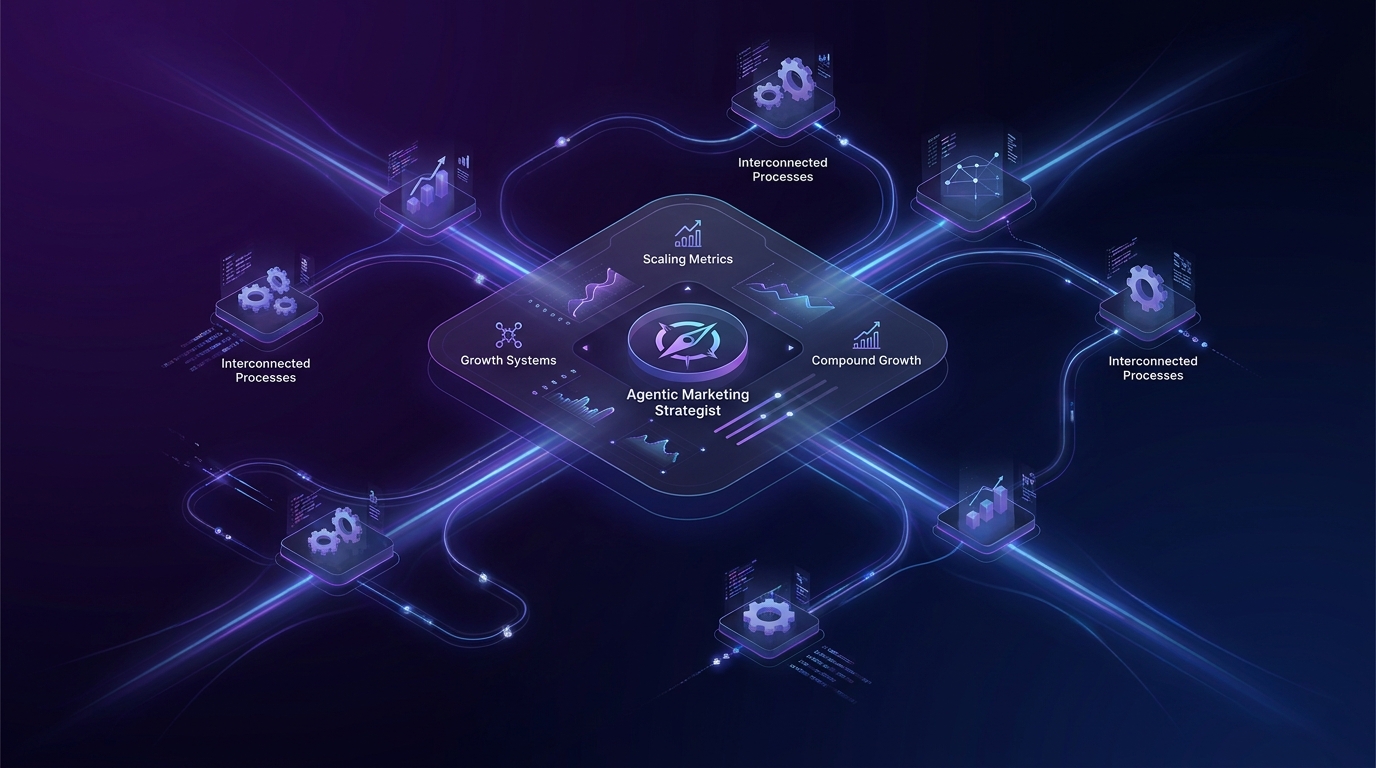
It is worth distinguishing this role from adjacent positions. A Marketing Automation Manager typically works inside a fixed platform like Marketo or HubSpot, configuring pre-built logic. An AI Marketing Analyst interprets model outputs but rarely builds or governs the pipelines producing them. The agentic marketing strategist spans both: they design the pipeline, govern the agents inside it, and translate the outputs into strategic decisions that affect budget allocation and go-to-market sequencing.
Core Competencies and Required Skills
Hiring managers across B2B SaaS, e-commerce, and agency environments consistently describe the same competency profile when they post for this role, even when the job title varies. The skillset is genuinely hybrid — part marketing strategist, part systems thinker, part light-touch technologist. You do not need to be an engineer, but you do need enough technical literacy to collaborate meaningfully with one.
For a comprehensive map of how these skills connect to broader career moves, the agentic AI for marketers guide provides a detailed breakdown of skill adjacencies and transition timelines.
| Competency | Proficiency Level Required | Why It Matters |
|---|---|---|
| AI Agent Architecture (tool use, memory, orchestration) | Intermediate – Advanced | You must design and audit agent workflows, not just use them |
| Prompt Engineering and System Prompting | Intermediate | Agent behavior is largely determined by how goals and constraints are specified |
| Marketing Strategy (funnel design, ICP, messaging) | Advanced | Agents execute what you define; strategic errors scale instantly |
| Data Analysis and Attribution Modeling | Intermediate | Multi-touch, agent-driven campaigns require sophisticated attribution logic |
| Martech Stack Management (CRM, CDP, ad platforms) | Intermediate | Agents must connect to existing data infrastructure; you own the integrations |
| Brand Safety and Compliance Governance | Intermediate | Autonomous systems can violate guidelines at scale without guardrails |
| Cross-functional Communication | Advanced | This role bridges engineering, legal, sales, and the C-suite |
| Experimentation and Hypothesis-Driven Thinking | Advanced | Agentic systems require structured test-and-learn frameworks to improve over time |
| Python or SQL (read-level) | Basic – Intermediate | Enough to read agent logs, query data pipelines, and debug simple integrations |
| Vendor Evaluation (LLM providers, orchestration platforms) | Intermediate | The tooling landscape shifts quarterly; you need to assess build vs. buy decisions |
Notice that Python sits at basic-to-intermediate — not advanced. Companies hiring for this role in 2026 are explicit that they do not want a pure engineer; they want a strategist who can hold a technical conversation without needing translation. If you can read a Python function, write a SQL SELECT statement, and understand what an API call does, you have enough technical floor to succeed here.
"The single biggest hiring mistake companies make with this role is treating it as an engineering position with a marketing background. It is a marketing leadership position that requires engineering fluency." — VP Marketing, Series C SaaS company, 2026
Day-to-Day Responsibilities
What does a Tuesday actually look like? The role blends strategic planning cycles with operational monitoring in a way that feels unfamiliar to marketers who have only run campaigns through traditional project management workflows. Here is a realistic breakdown of activities across a typical week.
Agent Pipeline Reviews (Daily, 30–45 min): Every morning begins with a review of agent performance dashboards. This means checking whether agents completed their assigned tasks, flagging anomalies (an agent that sent 4,000 emails at 2 AM because a trigger condition was misconfigured, for example), and approving or rejecting any agent outputs that sit in a human-review queue. Think of this as a morning standup with your AI team.
Strategy Architecture Sessions (2–3 per week): These are working sessions — often with a solutions engineer or a RevOps counterpart — where you design new agent workflows or refactor existing ones. You are writing goal definitions, specifying success criteria, mapping the tools an agent will call, and defining fallback logic for when an agent cannot complete a task autonomously.
Stakeholder Reporting (Weekly): Because agents touch multiple channels simultaneously, weekly reporting for this role is more complex than a standard campaign summary. You are attributing revenue influence across agent-generated touchpoints, explaining why the system made certain decisions, and justifying budget allocation recommendations that an agent's optimization logic produced.
Vendor and Platform Management (Ongoing): The orchestration platform landscape — tools like LangChain, CrewAI, Relevance AI, and proprietary enterprise platforms — moves fast. Part of this role is staying current on platform capabilities, negotiating contracts, and evaluating when a new tool offers enough capability lift to justify migration costs.
Brand Safety Audits (Monthly): You are responsible for reviewing samples of agent-generated content, ads, and outreach messages to ensure they remain on-brand, legally compliant, and aligned with current messaging priorities. As campaigns scale, this becomes a systematic sampling process rather than a full review.
Cross-functional Collaboration (Continuous): The agentic marketing strategist functions as the interpreter between the marketing strategy and the technical systems delivering it. You meet regularly with sales leadership to align agent-driven nurture sequences with pipeline priorities, with legal to update compliance guardrails, and with product teams to ensure launch campaigns are architectured correctly from the agent layer up.
Career Path and Progression
This role is new enough that there is no single canonical progression ladder, but a clear pattern is emerging across organizations that have invested seriously in agentic infrastructure. The trajectory moves from execution-focused roles into increasingly strategic and leadership-oriented positions.
Entry Point — Agentic Marketing Specialist (1–3 years experience): Typically transitions from a marketing automation manager, growth analyst, or digital campaign manager background. At this level, you are primarily configuring and monitoring existing agent pipelines designed by someone more senior, writing and testing prompts, and building reporting dashboards. Expect to spend 60–70% of your time in operational monitoring and configuration.
Core Role — Agentic Marketing Strategist (3–6 years experience): This is the fully autonomous version of the role described throughout this article. You own the architecture, the outcomes, and the team of specialists underneath you. At this level, you are reporting directly to a CMO or VP of Marketing and influencing how the entire company thinks about autonomous marketing systems.
Senior — Director of Agentic Marketing or Head of AI-Driven Growth (6+ years): At this tier, the focus shifts from single pipeline ownership to organizational capability building. You are defining the company's agentic marketing strategy across all business units, evaluating make-vs-buy decisions at a platform level, and potentially managing a team of four to eight specialists and strategists.
Executive — Chief Marketing Officer with Agentic Systems Ownership: The logical ceiling for this career path is a CMO role in an organization where agentic systems are central to go-to-market execution. Already in 2026, a meaningful subset of CMO job descriptions list agentic or autonomous systems governance as a core responsibility rather than a nice-to-have.
"The agentic marketing strategist who can demonstrate a 30%+ improvement in pipeline velocity through agent-optimized campaigns will be a CMO candidate within five years. This is the fastest-moving career trajectory in B2B marketing right now."
Lateral moves are also common and valuable. Strategists who build deep expertise in a specific vertical — SaaS, fintech, e-commerce — often move into fractional consulting roles, commanding $300–$500 per hour to help mid-market companies design their first agentic marketing infrastructure. Agencies are also hiring aggressively for these skills, and agency-side experience accelerates learning significantly because of the volume of different client architectures you encounter in a short time.
Salary Ranges: US and EU Benchmarks
Compensation for this role reflects both its novelty and its strategic leverage. Because the supply of qualified candidates remains thin relative to demand, companies are paying a significant premium over equivalent traditional marketing strategist roles — typically 25–40% above a comparably leveled campaign manager or marketing automation lead. The data below reflects 2026 market rates compiled from LinkedIn Salary, Glassdoor, and direct recruiter survey data.
| Level | US Base Salary (USD) | EU Base Salary (EUR) | Typical Total Comp (US) |
|---|---|---|---|
| Agentic Marketing Specialist (Entry) | $78,000 – $105,000 | €58,000 – €78,000 | $85,000 – $120,000 |
| Agentic Marketing Strategist (Mid) | $115,000 – $155,000 | €82,000 – €112,000 | $135,000 – $195,000 |
| Senior Agentic Marketing Strategist | $155,000 – $195,000 | €108,000 – €142,000 | $185,000 – $260,000 |
| Director of Agentic Marketing | $190,000 – $240,000 | €135,000 – €175,000 | $240,000 – $340,000 |
| Head of AI-Driven Growth (VP Level) | $230,000 – $290,000 | €160,000 – €210,000 | $300,000 – $450,000+ |
EU compensation varies significantly by country. Germany, the Netherlands, and Denmark sit at the top of the EU range, while Southern and Eastern European markets typically come in 15–25% below the figures shown. Remote roles based in high-cost-of-living US cities (New York, San Francisco, Seattle) push toward the upper end of the US ranges, while fully remote positions at distributed companies often land in the middle band regardless of the employee's location.
Total compensation at mid-to-senior levels almost always includes equity components at venture-backed companies. Performance bonuses tied to pipeline metrics generated by agent systems are also increasingly common, creating direct financial alignment between the strategist's work and business outcomes. Some companies are experimenting with agent-performance-linked bonuses — a genuinely novel compensation structure where a portion of variable pay is tied to metrics that autonomous systems hit, not just human campaign decisions.
How to Transition Into This Role
The most common question from experienced marketers is straightforward: I have five years in demand generation or marketing automation — how do I become an agentic marketing strategist without starting over? The answer is that you almost certainly do not need to start over. You need to layer specific technical and architectural knowledge on top of the marketing fundamentals you already own.
Step 1 — Build a Working Vocabulary (Month 1–2): Before you can architect agent systems, you need to understand how they work conceptually. This does not require engineering training. Spend four to six weeks learning the core concepts: what an LLM is, how tool use and function calling work, what orchestration means in an agent context, and what the difference is between single-agent and multi-agent pipelines. Free resources from Anthropic, OpenAI, and Google, plus structured courses on platforms like DeepLearning.AI, cover this at a non-engineering level.
Step 2 — Get Hands-On with One Platform (Month 2–4): Pick one agentic marketing or AI orchestration platform and build something real with it. Relevance AI, n8n, Make (formerly Integromat), and HubSpot's AI agent features are all accessible to non-engineers. Build a small agent workflow that solves an actual problem in your current job — perhaps an agent that drafts personalized follow-up emails for your sales team, or one that monitors competitor ad copy weekly and summarizes changes. Document what it does, what you learned, and what you would do differently.
Step 3 — Reframe Your Existing Experience (Ongoing): Your campaign management experience is directly relevant. The key is to reframe it in agentic terms. A multi-channel nurture campaign you built in Marketo is architecturally similar to a multi-agent marketing workflow — you defined goals, sequenced steps, set branching logic, and measured outcomes. Lead with this framing in your resume, portfolio, and interviews. Hiring managers are not expecting you to have built autonomous systems for five years; the discipline is too new. They are expecting you to demonstrate that your marketing instincts transfer and that you can learn the technical layer quickly.
Step 4 — Build a Portfolio Project (Month 3–6): The single most effective differentiator for candidates in 2026 is a documented agentic marketing portfolio project. This can be built in your current role, as a side project for a nonprofit, or in a structured bootcamp environment. The project should include a written architecture document describing what the agents do, what tools they call, what guardrails you implemented, and what results you measured. This is your proof of work.
Step 5 — Target the Right Job Titles (Month 6+): Companies are using inconsistent titles for this role. Search for: Agentic Marketing Strategist, AI Marketing Manager, Marketing AI Systems Lead, Growth Engineer (Marketing), Marketing Automation AI Lead, and Autonomous Campaign Manager. Filter for job descriptions that mention agent orchestration, LLM integration, or autonomous workflows — those are the roles that will genuinely advance your career in this direction rather than just adding an AI checkbox to a traditional campaign manager job description.
"Candidates who arrive with a documented portfolio project — even a small one — move through our hiring process in half the time of candidates who can only speak conceptually about agentic systems." — Recruiter at a Series B AI-native SaaS company, 2026
Frequently Asked Questions
What is the difference between an agentic marketing strategist and a marketing automation manager?
A marketing automation manager typically works within the predefined logic of platforms like HubSpot, Marketo, or Pardot — configuring triggers, sequences, and scoring rules that humans design upfront. An agentic marketing strategist works with autonomous AI agents that can plan, reason, and execute multi-step workflows independently, adapting to new information without requiring manual reconfiguration at each decision point. The strategist also owns the architectural design of those agent systems and is accountable for outcomes at a higher level of organizational leverage. In practice, many marketing automation managers are the most natural candidates to transition into the agentic strategist role.
Do I need to know how to code to become an agentic marketing strategist?
You do not need to be a software engineer, but basic technical literacy is genuinely required. The minimum viable technical skill set in 2026 includes the ability to read Python code and understand what it does, write SQL queries for basic data retrieval, understand API concepts, and navigate agent orchestration platforms without engineering support. Most hiring managers describe this as "technical enough to have a productive conversation with an engineer without a translator." If you can configure advanced settings in Zapier or Make and understand what a webhook is, you are probably at the right starting baseline.
How long does it take to transition into an agentic marketing strategist role from a traditional marketing background?
For an experienced marketing professional — someone with three or more years in demand generation, growth, or marketing automation — a focused transition typically takes six to twelve months. The first two to three months involve building conceptual knowledge and technical vocabulary. Months three through six focus on hands-on platform experience and building a portfolio project. The final phase involves a targeted job search using the strategic framing and proof-of-work portfolio developed in earlier stages. Those who transition faster typically have an existing employer willing to let them apply new skills in their current role, dramatically compressing the learning timeline.
What industries are hiring agentic marketing strategists in 2026?
B2B SaaS companies represent the highest concentration of open roles, accounting for an estimated 45% of job postings in this category as of mid-2026. E-commerce, fintech, and healthtech follow, with agencies building dedicated AI marketing practices rounding out the top five. Enterprise companies in traditional sectors like manufacturing and professional services are beginning to hire as well, though often under more generic titles like "AI Marketing Manager." The roles at AI-native companies and scale-ups tend to offer the most technically advanced work and the steepest learning curves, while enterprise roles typically offer more stability and clearer organizational support structures.
What are the biggest risks of the agentic marketing strategist role that nobody talks about?
The most underappreciated risk is attribution opacity — when multiple agents run simultaneously across channels, understanding which agent-driven touchpoint actually drove a conversion becomes genuinely difficult, and you are accountable for explaining it. Brand safety at scale is a second major risk: an agent misconfigured with a slightly wrong prompt can produce off-brand or legally problematic content across thousands of touchpoints before you catch it. A third risk is vendor lock-in; the orchestration platform you build your entire architecture on today may be acquired, shut down, or fundamentally changed within 18 months. Building with portability in mind is a strategic skill that separates experienced practitioners from those who are still learning.
Is the agentic marketing strategist role at risk of being automated itself?
The honest answer is: partially, over time, but not at the core of what makes it valuable. The routine monitoring, reporting, and configuration tasks within this role will increasingly be handled by agents themselves — there are already meta-agents designed to optimize other agents' performance. However, the strategic judgment layer — deciding which campaigns are worth running, how to interpret ambiguous results, how to align marketing systems with shifting business priorities, and how to navigate organizational politics — remains deeply human work. The strategists who will remain most valuable are those who continuously shift their effort toward higher-order judgment and systems design rather than operational execution.