AI overview traffic conversion rate data is finally catching up to the hype — and what it reveals should change how B2B SaaS and e-commerce teams allocate their optimization budgets in 2026. Referrals arriving from Google AI Overviews, ChatGPT, and Perplexity are converting at meaningfully different rates than organic search, and the gap between top-performing brands and laggards is widening fast. If you're not benchmarking AI-driven traffic separately, you're flying blind on one of the fastest-growing acquisition channels of the year.
AI Overview Traffic Conversion Rate: What the Data Actually Shows
For most of 2024 and early 2025, marketers speculated about whether AI-referred visitors were high-intent or tire-kickers. By mid-2026, the picture is considerably clearer — and it's more nuanced than either camp predicted. AI Overview traffic is not monolithic. Conversion rates vary dramatically based on the source (Google AI Overviews vs. ChatGPT vs. Perplexity), the category of query, and how well the landing page is tuned to answer the implicit question the AI already answered for the user.
Across aggregated data from hundreds of B2B SaaS and e-commerce sites analyzed in early 2026, AI-referred sessions convert at an average of 3.1% for e-commerce and 2.4% for B2B SaaS — compared to 1.9% and 1.6%, respectively, for standard organic search. On the surface, that looks like a clear win for AI referrals. But the distribution is extremely uneven: the top quartile of sites sees conversion rates above 5.8% from ChatGPT and Perplexity referrals, while the bottom quartile sits below 1.1%, worse than baseline organic.
"Sites that appear in AI Overviews for bottom-of-funnel queries convert referred traffic at 2.3x the rate of those cited only for informational queries — yet only 18% of brands have optimized their pages with this distinction in mind." — Conversion benchmarking analysis, Q1 2026
The core dynamic driving this divergence is query intent alignment. When a user asks ChatGPT "What is the best project management software for a 50-person agency?" and clicks through to your pricing page, they've already been pre-qualified by the AI. Your job is to confirm what the model already implied — not re-educate. Sites that fail to mirror the AI's framing in their headline, trust signals, and CTA structure waste this head start entirely. For a deeper operational playbook, see our guide on AI search traffic conversion optimization, which covers page-level tactics for each major AI source.
Benchmarks by Segment: B2B SaaS vs. E-Commerce
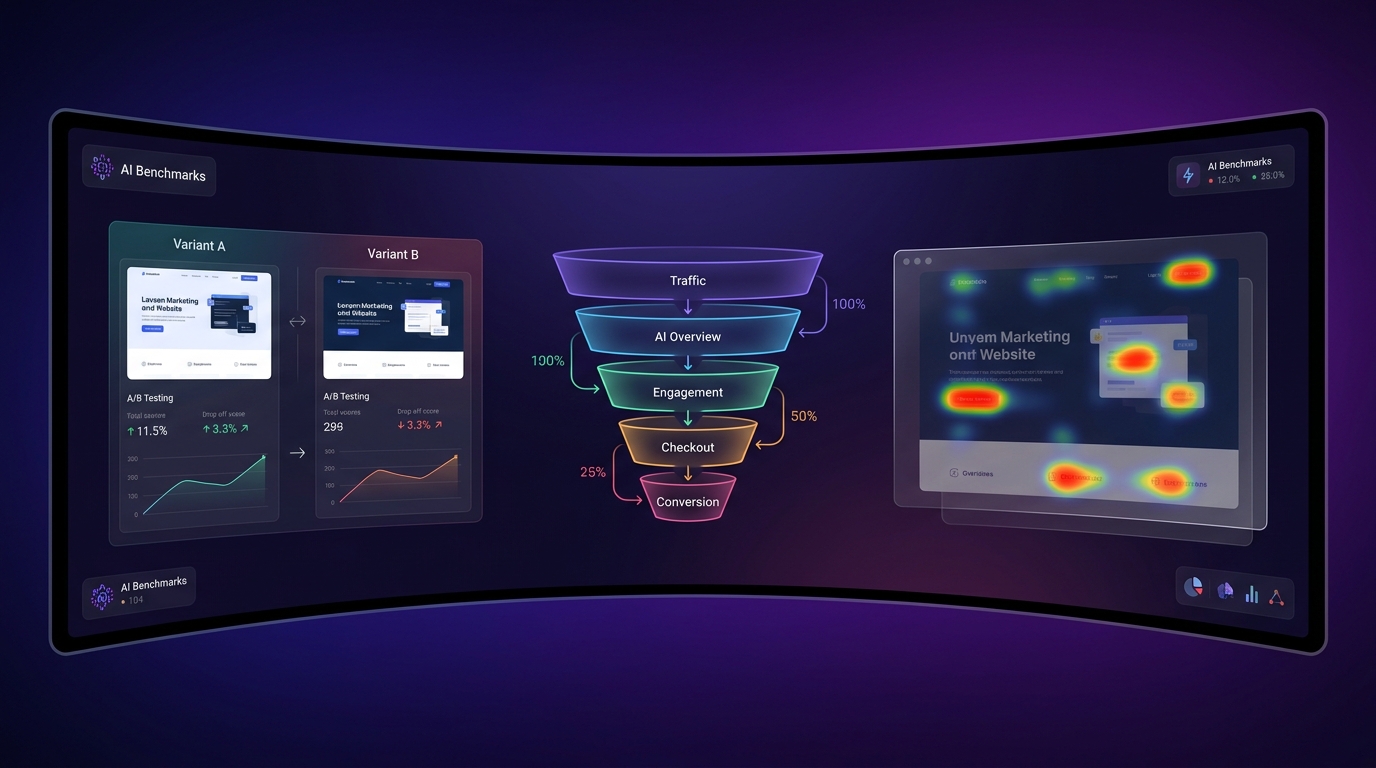
Understanding your numbers requires comparing them to the right peer group. A 2.5% conversion rate from Perplexity referrals might be exceptional for an enterprise HR platform and disappointing for a DTC skincare brand. The table below reflects median and top-quartile conversion rates observed across AI referral sources in 2026, segmented by business type and query category.
| Segment | AI Source | Query Type | Median CVR | Top Quartile CVR |
|---|---|---|---|---|
| B2B SaaS | ChatGPT | Best-of / comparison | 2.9% | 6.1% |
| B2B SaaS | Perplexity | Problem-solution | 2.6% | 5.4% |
| B2B SaaS | Google AI Overviews | Informational | 1.3% | 2.8% |
| E-Commerce | ChatGPT | Product recommendation | 3.8% | 7.2% |
| E-Commerce | Perplexity | Best-of / comparison | 3.4% | 6.5% |
| E-Commerce | Google AI Overviews | Informational | 1.7% | 3.1% |
Several patterns stand out immediately. First, Google AI Overviews consistently underperform ChatGPT and Perplexity across both segments — likely because AI Overview citations often occur on informational queries where purchase intent is lower. Second, e-commerce product recommendation queries from ChatGPT are the single highest-converting AI traffic type observed, reflecting the platform's growing role as a personal shopping assistant. Third, B2B SaaS brands that appear for comparison queries on ChatGPT nearly match e-commerce CVRs, which is a significant shift from traditional B2B conversion norms.
If your B2B SaaS numbers are trailing the median, detailed pipeline attribution data can help you identify whether the problem is traffic quality, landing page friction, or offer misalignment. Our analysis of AI-referred traffic benchmarks B2B SaaS breaks this down by source, including bounce rate and downstream pipeline contribution, which are often more telling than raw CVR alone.
Why AI Referral Traffic Converts Differently — and What to Do Now
AI-referred users arrive at your site in a fundamentally different cognitive state than someone who clicked a blue link. They've already received an answer — your citation is validation, not discovery. This creates both an opportunity and a failure mode that conventional CRO wisdom doesn't fully address.
The opportunity: these visitors have a compressed decision timeline. They're not in early research mode; they're confirming a shortlist. A landing page that immediately demonstrates why the AI's recommendation was correct — through social proof calibrated to the use case mentioned in the query, specific outcome data, and a low-friction next step — can convert at multiples of standard organic rates.
The failure mode: if your landing page forces them through a generic awareness-stage journey (long explainer copy, vague value propositions, no immediate evidence), the cognitive mismatch is jarring. These users bounce fast. Analysis of session recordings from AI-referred traffic shows that pages with a time-to-first-meaningful-content over 3.5 seconds lose 61% of AI referral visitors before a single scroll — a significantly higher abandonment rate than for standard organic visitors.
Practical fixes that move the needle quickly include: (1) adding a headline variant that mirrors common AI query framings for your category; (2) placing your strongest third-party validation (G2 rating, analyst quote, customer logo) above the fold rather than mid-page; (3) offering a free trial or demo CTA within the first viewport rather than anchoring it at the bottom. For e-commerce, the equivalent is ensuring product pages cited in AI responses load with in-stock confirmation, pricing clarity, and review count visible without scrolling. Our resource on Google AI Mode e-commerce conversion optimization details exactly how to structure product pages for maximum add-to-cart rates from AI citations.
What's Coming Next for AI-Driven Conversion
The conversion dynamics described above reflect where the market stands in mid-2026 — but several shifts are already in motion that will reshape benchmarks over the next 12 to 18 months.
Personalized AI citations are emerging as a meaningful variable. Both ChatGPT and Perplexity are beginning to factor in individual user history when selecting which brands to cite, which means the same query can return different recommendations for different users. For conversion teams, this will make it harder to rely solely on broad citation volume as a leading indicator and will push attention toward citation quality signals — review recency, structured data accuracy, and content specificity — as the levers that influence which version of a user's AI sees your brand.
Native commerce integrations are accelerating. ChatGPT's shopping features, which began scaling in late 2025, now allow users to complete purchases without leaving the chat interface in certain categories. This will depress click-through volume from AI sources even as citation frequency increases — meaning conversion rate calculations will need to account for transactions that never touch your site. Brands that establish direct integrations with AI shopping layers early will capture revenue that otherwise disappears from measurement entirely.
Finally, attribution is maturing. UTM parameter stripping by AI platforms has been a persistent headache, but server-side tagging improvements and platform-level analytics partnerships (Perplexity's publisher analytics program being the most notable example) are giving brands cleaner data pipelines. Expect the benchmarks in the table above to become more granular and actionable as measurement gaps close through the remainder of 2026.
Frequently Asked Questions
What is a good conversion rate for traffic from Google AI Overviews?
For e-commerce, a median conversion rate from Google AI Overview referrals is approximately 1.7%, with top-performing sites reaching 3.1% or higher. For B2B SaaS, the median sits around 1.3%, with top-quartile performance at roughly 2.8%. Because AI Overviews often appear for informational queries, CVRs tend to be lower than traffic from ChatGPT or Perplexity, where purchase-intent queries are more common.
Does ChatGPT or Perplexity send higher-converting traffic?
Both ChatGPT and Perplexity generally outperform Google AI Overviews in conversion rate, but ChatGPT holds a slight edge in 2026 data — particularly for e-commerce product recommendation queries, where median CVRs reach 3.8% compared to Perplexity's 3.4%. The gap likely reflects ChatGPT's larger user base and its more aggressive expansion into shopping-assistant use cases. Perplexity referrals tend to skew toward research-heavy queries, which can produce high-intent but longer sales cycles in B2B contexts.
How do I track conversion rates from AI Overview traffic separately in GA4?
In GA4, you can segment AI-referred traffic by creating a custom channel group that isolates sessions where the session source/medium matches known AI platform domains (chat.openai.com, perplexity.ai, gemini.google.com, and the SGE referral parameter from Google). Because some AI platforms strip UTM parameters, pairing GA4 with server-side tagging and regular cross-referencing against your CRM's lead source field will give you the most complete picture. Set up a dedicated conversion report segment for each AI source so you can track CVR trends over time rather than relying on aggregated organic figures.
Why is my AI referral traffic converting worse than regular organic traffic?
The most common cause is landing page mismatch — your page is structured for early-funnel discovery, but AI-referred users arrive expecting confirmation of a decision they've already partially made. Check whether your headline, above-the-fold social proof, and primary CTA align with the type of query that generated the citation. A secondary cause is citation context: if you're primarily being cited for informational content rather than bottom-of-funnel pages, traffic quality will naturally be lower.
Are AI overview conversion rates improving over time?
Yes — but unevenly. Brands that have actively optimized their pages for AI-referred visitors are seeing year-over-year CVR improvements of 30–50% from these sources, while those using a set-and-forget approach are seeing rates stagnate or decline as competition for citations intensifies. The overall market median is rising modestly, but the spread between top and bottom performers is widening, making proactive optimization increasingly consequential.