MCP SEO automation is reshaping how search professionals manage everything from technical audits to content pipelines — replacing disconnected manual workflows with coordinated AI agents that act on live data. Model Context Protocol (MCP) gives those agents a standardized way to call external tools, retrieve context, and execute multi-step SEO tasks without constant human hand-holding. If you work in SEO and haven't mapped out an MCP strategy yet, you're already behind the teams that have.
What MCP SEO Automation Actually Means
Model Context Protocol is an open standard — originally developed by Anthropic and now adopted across the AI tooling ecosystem — that defines how AI agents communicate with external data sources and tools in a structured, permission-aware way. In plain terms: MCP is the connective layer that lets an AI model reach out to your SEO platform, pull a site audit report, interpret the findings, and trigger the next action, all within a governed pipeline.
Before MCP, connecting an AI model to an SEO tool required custom API wrappers, brittle prompt engineering, and a developer standing by to patch things when the integration broke. MCP standardizes that handshake. A tool exposes an MCP server; an AI agent calls it through a defined protocol; the agent receives structured context it can reason over. The result is a plug-and-play composability that didn't exist at scale before 2025.
MCP SEO automation, then, is the application of this protocol to search engine optimization workflows: keyword research, technical audits, backlink analysis, content gap identification, rank tracking, and reporting. Rather than an SEO analyst running each of these tasks in separate tabs, an orchestrated set of AI agents handles them sequentially or in parallel, surfacing only the decisions and edge cases that genuinely require human judgment.
"Teams that have moved routine SEO data tasks to agent pipelines report reclaiming 60–70% of analyst time previously spent on data gathering and formatting — time that gets redirected to strategy and creative work."
This isn't about replacing SEO professionals. It's about eliminating the mechanical drudgery that prevents them from doing the high-leverage work that actually moves rankings.
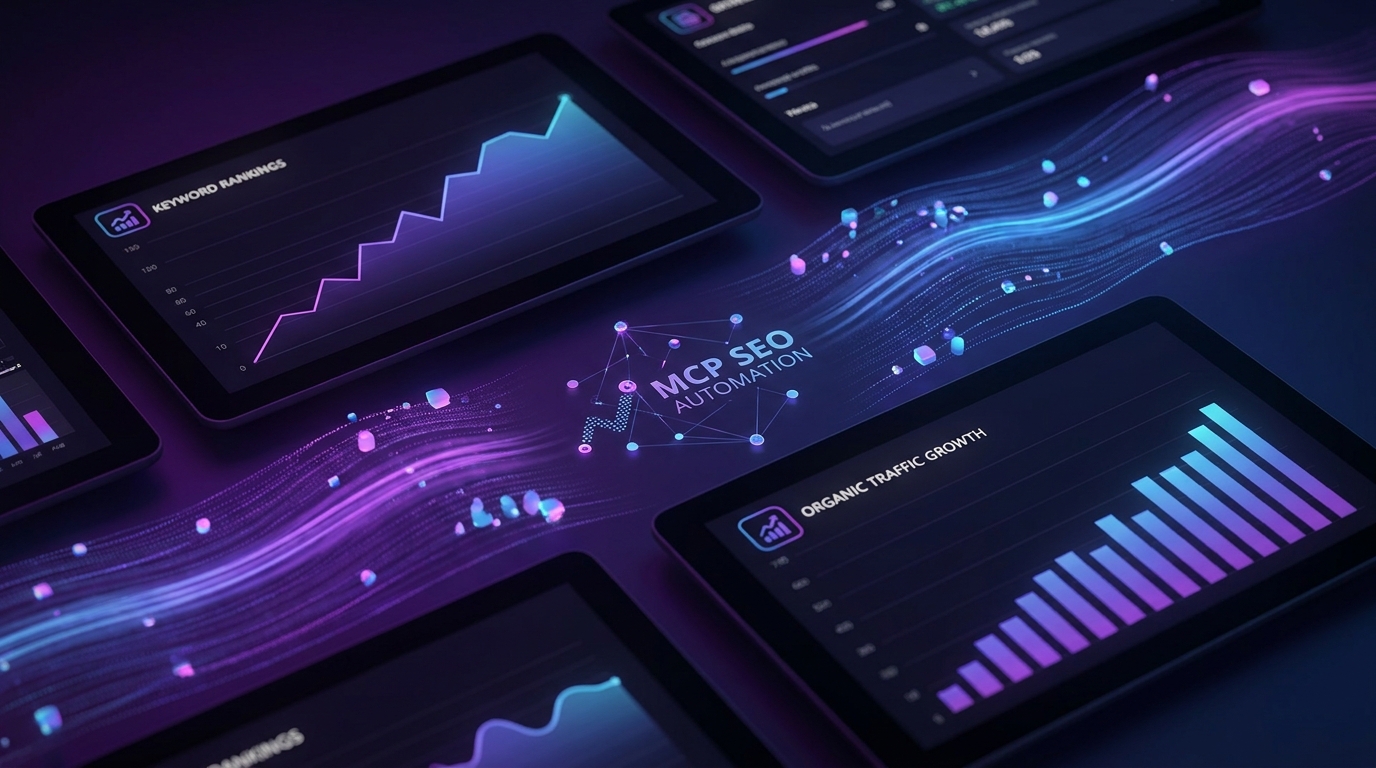
Why MCP Changes the SEO Productivity Equation
Traditional SEO workflows are fundamentally serial and human-gated. An analyst pulls a crawl report, exports it to a spreadsheet, identifies issues, writes a brief for a developer, waits for fixes, then re-crawls to verify. Each handoff introduces lag. A site with 50,000 pages and a monthly audit cadence simply can't be monitored with the granularity it needs under this model.
MCP collapses those handoffs. An agent with access to a crawl tool, a CMS API, and a task management MCP server can identify a batch of broken internal links, generate fix recommendations formatted for the dev team's ticketing system, and log the audit finding — in one pipeline run. What took three days of analyst time can happen overnight.
The comparison below captures how traditional and MCP-augmented approaches differ across the core dimensions SEO teams care about most.
| Workflow Dimension | Traditional SEO Approach | MCP-Powered AI Agent Approach |
|---|---|---|
| Audit frequency | Monthly or quarterly, resource-limited | Continuous or on-demand, automated triggers |
| Data integration | Manual exports, spreadsheet merges | Live tool calls via MCP servers, unified context |
| Keyword research | Analyst-driven, sequential platform checks | Agent queries multiple platforms in parallel, synthesizes gaps |
| Reporting | Manual compilation, 4–8 hours per report | Agent-generated narratives from live data, minutes to produce |
| Error detection | Reactive, discovered after traffic drops | Proactive, flagged as crawl anomalies arise |
| Scale ceiling | Constrained by team headcount | Scales with compute budget, not headcount |
| Permission governance | Ad hoc, tool-by-tool | Centralized MCP permission layer, auditable |
The productivity gap widens as site complexity grows. Enterprise sites with multiple subdomains, international hreflang configurations, and large-scale content programs gain the most from MCP automation — but mid-market teams running leaner operations see equally dramatic efficiency gains because they lack the headcount to keep up manually.
Core Components of an MCP-Powered SEO Stack
Building an effective MCP SEO automation system requires understanding its architectural layers. There are four you need to get right.
1. The Orchestration Layer
This is the AI model or agent framework that receives goals, plans steps, and calls tools. Options in 2026 include Claude (with native MCP support), GPT-based agents via OpenAI's tool-calling interface, and open-source frameworks like LangGraph or AutoGen. The orchestrator decides which MCP servers to call, in what order, and how to combine their outputs into coherent action.
2. MCP Servers (Tool Integrations)
Each external capability — a crawl platform, a keyword database, a content management system — is exposed through an MCP server. The server defines what "tools" the agent can invoke (e.g., get_crawl_report, query_keyword_volume, fetch_backlink_profile) and what parameters each tool accepts. Well-structured MCP servers include schema validation and rate-limit handling so agents don't hammer APIs.
3. The Context and Memory Layer
MCP agents need persistent context to be useful across sessions. A site's crawl history, keyword ranking trends, and content calendar live here. Without memory, every agent run starts cold. With it, an agent can say: "Compared to last month's crawl, 340 new 404 errors appeared — here's the cluster by directory." This longitudinal awareness is what separates a toy demo from a production-grade SEO system.
4. The Permission and Governance Layer
This is the component most teams underinvest in. MCP's design includes structured permission scopes — an agent should be able to read crawl data without also having write access to your CMS, for example. Defining least-privilege access per agent role is non-negotiable for enterprise deployments. Detailed guidance on governance models is covered in our piece on AI agents for technical SEO audit pipelines.
"The teams that struggle with AI SEO automation almost always have the same root problem: they gave their agents too much access and too little structure, then blamed the technology when things went sideways."
How to Implement MCP for SEO: A Practical Roadmap
Implementation doesn't have to be an all-or-nothing leap. The highest-ROI path is to start with one contained workflow, prove value, then expand the agent surface area. Here's a sequenced roadmap that works for teams ranging from solo consultants to in-house enterprise SEO departments.
Phase 1: Audit and Map Your Current Workflows (Weeks 1–2)
Document every recurring SEO task your team performs: what data it requires, which tools it touches, how long it takes, and what the output is. Tag each task as "fully automatable," "agent-assisted," or "human-only." You'll find that 40–60% of recurring tasks fall into the first two categories — these are your MCP targets.
Phase 2: Stand Up Your First MCP Server (Weeks 2–4)
Pick one high-frequency task — rank tracking report generation is a common starting point — and connect it to an MCP server. If your rank tracker has an API, building a lightweight MCP wrapper is a half-day engineering task. Test it with a local agent before wiring it into your orchestration layer.
Phase 3: Build the First Agent Pipeline (Weeks 4–8)
Design a pipeline for your chosen workflow: define the goal prompt, the tool sequence, the output format, and the human review checkpoint. Run it in shadow mode — the agent does the work, a human verifies the output before it's acted upon. This generates the ground-truth data you need to calibrate the agent's behavior and catch edge cases before they cause damage.
Phase 4: Expand and Interconnect (Months 3–6)
Once your first pipeline is stable, add adjacent workflows. Keyword research, content briefing, and technical audit pipelines compose naturally — the output of one becomes the input of the next. Full SEO workflow automation with AI agents at this level is where the compounding productivity gains appear. By month six, teams typically have five to eight interconnected agent pipelines covering the majority of their operational SEO work.
Phase 5: Govern, Monitor, and Iterate
Automation without monitoring is just deferred chaos. Log every agent action, track output quality over time, and set up alerting for anomalous behavior (an agent making an unusual number of tool calls in a short window is often a sign something has gone wrong upstream). Quarterly audits of your permission scopes keep the governance layer honest as your agent portfolio grows.
MCP SEO Tools and Integrations Worth Using
The MCP ecosystem for SEO tools has matured considerably. Here are the integration categories delivering the most measurable value in 2026, along with specific implementation notes.
Keyword and Competitive Intelligence Platforms
Connecting keyword research platforms to MCP agents unlocks automated gap analysis at a scale no analyst team can match manually. An agent can pull your current rankings, compare them against competitor positions, identify clusters where you're losing share, and generate a prioritized briefing — daily if you want. Our dedicated guide on Semrush MCP integration walks through the exact server configuration and tool schema for one of the most widely used platforms in this category.
Backlink and Link Intelligence
Backlink data is voluminous and changes constantly. MCP agents excel at monitoring link velocity, flagging toxic link patterns, and identifying high-authority linking opportunities from competitor profiles. The Ahrefs Model Context Protocol setup covers how to structure queries so agents retrieve the right data slices without hitting rate limits — a detail that breaks naive implementations.
Technical SEO and Crawl Platforms
Crawl platforms with MCP integrations turn technical audits from periodic events into continuous monitoring loops. Agents can detect page speed regressions, new crawl errors, and Core Web Vitals anomalies as they appear, then cross-reference them against deployment logs to identify likely causes. This closes the feedback loop between engineering changes and SEO impact to hours rather than weeks.
Content and CMS Integrations
Content pipeline agents connected to CMS platforms via MCP can handle brief generation, internal linking suggestions, metadata optimization, and content refresh scheduling — all triggered by performance signals rather than arbitrary editorial calendars. Teams using this approach report dramatically higher content ROI because every piece of work is data-driven rather than intuition-driven.
"The integration that surprises most teams is the CMS connection — the ability to push structured content recommendations directly into a draft workflow, without a human intermediary, turns out to be where the biggest time savings materialize in practice."
Common Mistakes That Kill MCP SEO Projects
Most MCP SEO automation projects that fail do so for predictable, avoidable reasons. Here are the six most common, with concrete guidance on how to avoid each.
1. Automating Broken Workflows
If your keyword research process is disorganized, automating it makes a faster mess. Before connecting an MCP agent to any workflow, standardize the process manually first. Agents amplify what's already there — clarity and chaos alike.
2. Skipping the Shadow Mode Phase
Deploying agents directly to production without a verification period is how you end up with 10,000 auto-generated meta descriptions that are technically correct but strategically wrong. Run every new pipeline in shadow mode until its output quality is consistently verified against human baselines.
3. Over-Permissioning Agents
Giving an agent write access to systems it only needs to read from creates unnecessary risk. An agent that can both crawl your site and push changes to your CMS without a human checkpoint is a liability. Enforce least-privilege access at the MCP server level.
4. Ignoring Output Drift
Agent output quality can degrade over time as your site structure changes, your tooling updates, or the underlying model is refreshed. Without monitoring, you may not notice until something breaks. Log outputs, spot-check regularly, and build quality metrics into your review cadence.
5. Building Monolithic Pipelines
A single agent trying to do everything — crawl, analyze, brief, publish — is fragile. Modular pipelines where each agent has one clear responsibility are easier to debug, maintain, and upgrade independently.
6. Treating MCP as a Replacement for SEO Expertise
MCP agents execute instructions. They don't develop search strategy, interpret ambiguous algorithm signals, or build the stakeholder relationships that get SEO buy-in. Teams that cut their SEO expertise to fund their automation infrastructure consistently underperform teams that invest in both.
The Future of AI-Driven SEO Workflows
The trajectory from here is toward fully autonomous SEO agents operating within bounded governance frameworks — not as a distant possibility but as an emerging operational reality for the most sophisticated teams. Several developments are converging to accelerate this.
Multi-agent coordination is maturing fast. Rather than a single agent handling a complex SEO workflow, orchestrated fleets of specialized agents — one focused on technical health, one on content performance, one on link intelligence — will collaborate asynchronously, with a supervisory agent synthesizing their outputs into unified recommendations. The productivity ceiling for individual agents is much lower than for coordinated agent networks.
Real-time search signal integration is the next frontier. As search engines release more structured data about indexing behavior and ranking signals (however limited that release may be), MCP servers that ingest and normalize this data will give agents an early-warning system for algorithmic changes that currently takes weeks to detect through rank tracking alone.
Personalized SEO agent configurations tailored to industry verticals — e-commerce, SaaS, publishing, local — will reduce the setup overhead that currently keeps mid-market teams from deploying MCP systems. Pre-configured tool schemas, governance templates, and pipeline blueprints by vertical are already appearing in the ecosystem and will become standard tooling within 18 months.
Perhaps most importantly, the feedback loops between SEO agents and content creation agents will tighten. A ranking dip detected by an SEO monitoring agent will automatically trigger a content refresh brief, which a content agent populates with current competitive context, which a human editor reviews and approves. The human remains in the loop for quality and judgment — but the preparatory work that used to consume days happens in hours. That is the compounding advantage MCP SEO automation offers teams willing to build it properly.
Frequently Asked Questions
What is Model Context Protocol (MCP) and how does it relate to SEO?
Model Context Protocol is an open standard that defines how AI agents communicate with external tools and data sources in a structured, permission-controlled way. In SEO, MCP allows AI agents to connect to platforms like crawl tools, keyword databases, and analytics systems so they can retrieve data, analyze it, and take actions — all within a governed workflow. It replaces the fragile, custom API integrations that previously made AI-SEO tool connections impractical at scale.
Do I need a developer to implement MCP SEO automation?
For basic MCP setups using existing MCP server packages, a technically proficient SEO professional with some scripting experience can get started without dedicated engineering support. More complex deployments — custom MCP servers, multi-agent orchestration, CMS write integrations — typically require engineering involvement, particularly for governance and security configuration. The ecosystem is developing no-code and low-code tooling that will lower this bar further, but in 2026 most production implementations still involve at least some developer time.
Which SEO tasks are best suited for MCP automation?
Highly structured, data-intensive, recurring tasks deliver the best automation ROI: crawl error monitoring, rank tracking report generation, backlink velocity analysis, keyword gap identification, metadata auditing, and internal link opportunity surfacing. Tasks requiring nuanced judgment — search strategy, content differentiation, stakeholder communication — are better handled by humans using agent-generated inputs as context rather than direct outputs.
Is MCP SEO automation safe for enterprise use?
Yes, when implemented with proper governance — which is the critical qualifier. MCP's protocol design includes permission scoping that lets you define exactly what each agent can and cannot do. Enterprise implementations should enforce least-privilege access per agent role, maintain full audit logs of agent actions, require human approval checkpoints for any write operations, and conduct regular permission scope reviews. Skipping any of these steps introduces meaningful risk regardless of the underlying technology.
How long does it take to see ROI from MCP SEO automation?
Teams that start with one well-defined high-frequency workflow typically see measurable time savings within four to six weeks of deploying their first stable pipeline. Full ROI — where the time reclaimed across multiple pipelines exceeds the implementation and maintenance investment — usually materializes between three and six months for mid-market teams and within the first quarter for enterprise teams with dedicated resources. The key variable is how much time your team currently spends on tasks that are genuinely automatable.
What's the difference between MCP and traditional SEO API integrations?
Traditional API integrations are point-to-point: you write custom code to connect Tool A to Tool B, handle authentication, parse responses, and manage errors — and repeat this for every new tool. MCP standardizes that entire handshake so any MCP-compatible agent can call any MCP-compatible server using the same protocol. The practical difference is composability: adding a new tool to an MCP agent stack takes hours, not weeks, and doesn't require rebuilding existing integrations.
Can MCP agents replace SEO professionals?
No — and framing the question this way misunderstands what MCP does well. Agents excel at executing structured, data-driven tasks at speed and scale. They don't develop search strategy, interpret ambiguous signals, build relationships that generate editorial links, or make nuanced judgment calls about brand voice and topical authority. The most effective SEO operations in 2026 use MCP agents to handle operational execution, freeing human professionals to focus on the strategic and creative work that actually determines competitive outcomes.
What AI models work best with MCP for SEO automation?
Claude (from Anthropic) has native MCP support and is the most widely deployed model in production MCP SEO pipelines as of 2026. GPT-4 and later OpenAI models support equivalent tool-calling functionality and integrate well in agent frameworks like LangGraph and AutoGen. The choice of model matters less than the quality of your MCP server design, your prompt architecture, and your governance configuration — teams that obsess over model selection while underinvesting in these areas consistently underperform teams that do the opposite.