
Server-side conversion tracking is rapidly becoming the measurement standard for advertisers who need accurate, privacy-compliant data in an era of aggressive browser restrictions, ad blockers, and tightening consent regulations. Unlike browser-based pixels that lose signal every time a user blocks scripts or clears cookies, server-side tracking routes event data through your own infrastructure before sending it to ad platforms — recovering conversions that would otherwise vanish entirely. This guide covers every layer of the decision: architecture selection, platform implementation, deduplication, PII handling, and how the switch affects your bidding algorithms.
What Is Server-Side Conversion Tracking?
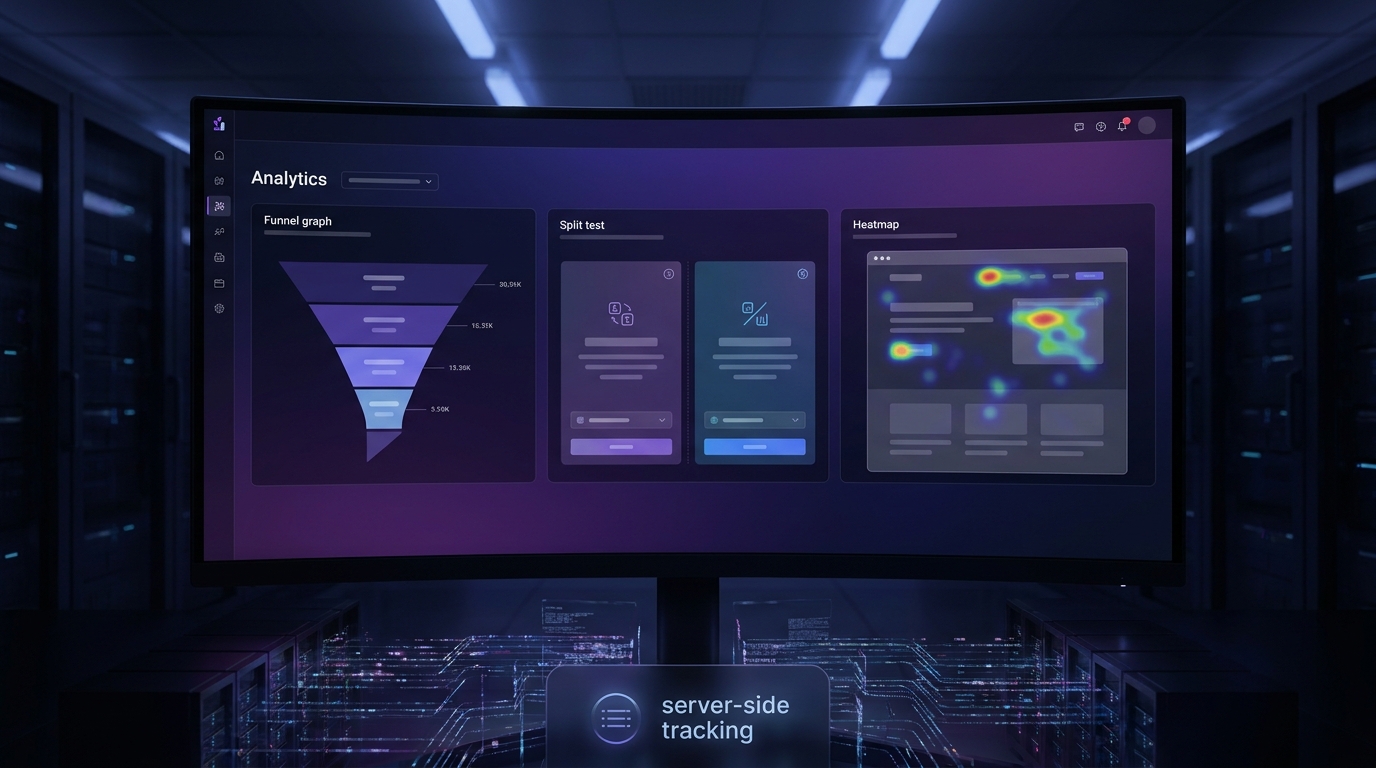
Server-side conversion tracking is a measurement architecture in which your own server — not the user's browser — sends conversion event data directly to advertising platforms and analytics tools. When a purchase, lead form submission, or other conversion happens, the data travels from your application to a server you control, which then forwards a structured event payload to Google Ads, Meta, TikTok, or whichever platform you're running campaigns on.
The key phrase is "server you control." That server sits between your website or app and the ad platforms, giving you a trusted intermediary that is invisible to browser extensions, immune to Intelligent Tracking Prevention (ITP), and not subject to JavaScript failures caused by slow page loads or tag conflicts. It also becomes a data enrichment layer — a place where you can append CRM identifiers, customer lifetime value scores, or offline purchase data before the event reaches the platform's API.
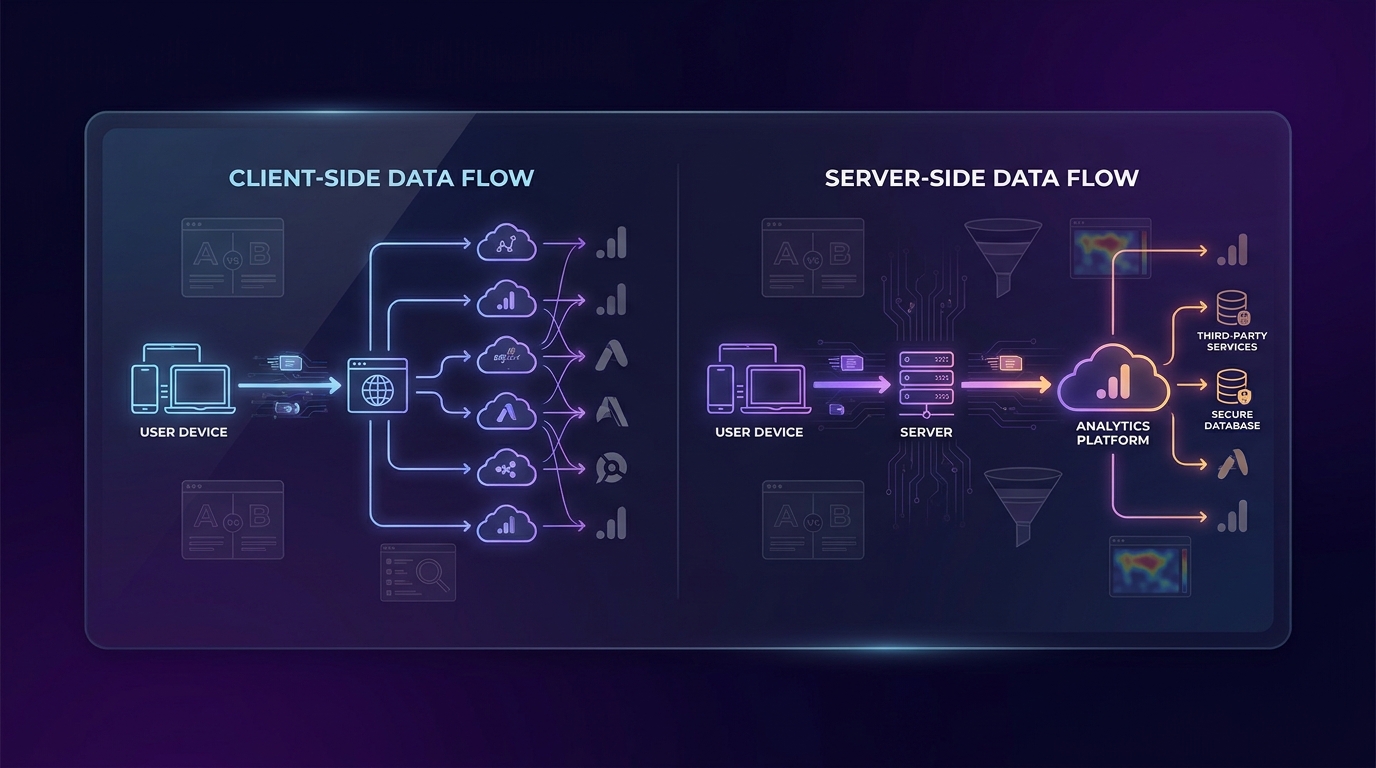
Think of it as the difference between sending a letter yourself (client-side: the user's browser sends data) versus having a courier service you own pick it up, verify it, and guarantee delivery (server-side: your infrastructure handles the relay). The destination is the same; the reliability and control are fundamentally different.
"Industry practitioners consistently report that switching from browser-only pixels to server-side event APIs recovers between 15% and 30% of conversion events that were previously going untracked — a gap that grows as browser privacy protections intensify."
This measurement method is sometimes called server-to-server (S2S) tracking, first-party event forwarding, or API-based conversion tracking. The names vary by vendor, but the underlying architecture is the same: your server, your data, your relay to the platform.
Client-Side vs. Server-Side: How the Data Flow Actually Differs
Understanding the failure modes of client-side tracking is the fastest way to understand why server-side exists. The table below maps the full data journey for each approach and highlights where signal is lost.
| Dimension | Client-Side (Browser Pixel) | Server-Side Conversion Tracking |
|---|---|---|
| Where the event fires | User's browser (JavaScript) | Your application server or tag server |
| Ad blocker vulnerability | High — most blockers strip pixels | None — request originates server-to-server |
| ITP / cookie lifespan | 1–7 days on Safari; degraded matching | First-party cookies set server-side persist up to 400 days |
| PII control | Limited — data leaves browser directly | Full — hash, filter, or enrich before sending |
| Data enrichment | Browser context only | CRM data, LTV, offline events can be appended |
| Latency | Near-instant on page load | 50–200ms server processing; manageable with async queues |
| Implementation complexity | Low (copy-paste tag) | Medium to high (requires server infrastructure) |
| Maintenance burden | Low short-term, fragile long-term | Higher upfront, more stable long-term |
| GDPR / CCPA compliance posture | Harder to enforce consent signals | Consent signals enforced at server layer before forwarding |
| Attribution model impact | Baseline (what you're used to) | Typically higher reported conversions; requires bidding recalibration |
The latency trade-off deserves a closer look. A server-side pipeline introduces processing time between the conversion event and the API call. For most bidding purposes this is inconsequential — ad platforms accept events retroactively for hours or days. Where it can matter is real-time personalization use cases. The solution is asynchronous processing: fire the server-side event to a queue (Pub/Sub, Kafka, SQS) immediately, process and forward it within seconds, and the latency becomes operationally invisible.
Why Client-Side Tracking Is Breaking Down
The convergence of four independent forces is accelerating the decline of pixel-based measurement, and each one compounds the others.
Ad blockers and script blockers. Industry data suggests that between 25% and 40% of desktop users in developed markets run some form of ad or script blocking. Every one of those users is invisible to your pixel. This isn't a future risk — it's current signal loss that has been building for years.
Intelligent Tracking Prevention and browser privacy features. Safari's ITP caps JavaScript-set cookies at seven days and, in some configurations, one day. Firefox's Enhanced Tracking Protection takes a similar approach. Chrome's own Privacy Sandbox continues to evolve. The result is that returning customers who purchased more than a week ago may not be matched to the original click, fracturing attribution windows.
Third-party cookie deprecation. While timelines have shifted repeatedly, the direction is settled: third-party cookies are a diminishing asset. Cross-site tracking that ad platforms relied on for view-through and cross-device attribution is contracting, making first-party signals from server-side APIs the only reliable substitute.
Consent regulations. GDPR, CCPA, and their successors require that tracking consent be collected, recorded, and honored. A browser pixel that fires before a consent signal is evaluated — or that continues firing after a user opts out — creates legal exposure. Server-side architecture allows you to gate the API call on a validated consent decision rather than relying on the browser to suppress a pixel that has already loaded. For a detailed breakdown of how to stay compliant without breaking measurement, see our guide on server-side tracking consent compliance.
"Many performance marketers don't realize how much signal they've already lost. When you layer ad blocker rates, ITP-shortened attribution windows, and consent opt-outs together, the effective tracking rate for a browser pixel on a typical e-commerce site can be well below 70% of actual conversions."

Core Benefits: Accuracy, Compliance, and First-Party Data Enrichment
The measurable accuracy improvement is the most compelling argument for server-side conversion tracking. A documented retail case study from Stape recorded 8,841 conversions with server-side cookies versus 7,466 with client-side cookies — an 18.26% increase in tracked conversions from the same underlying customer activity. That delta directly impacts smart bidding: more conversion signals mean better-optimized Target CPA and Target ROAS campaigns.
But accuracy is only one dimension. The three compounding benefits are:
1. Compliance by design. When consent enforcement happens at the server layer, you can filter event payloads before they ever reach a platform API. A user who declined analytics consent never generates a server-side API call — there's no race condition between pixel firing and consent script loading that characterizes browser implementations.
2. First-party data enrichment. This is the most underappreciated advantage. Because the event passes through your server, you can join it against your CRM, loyalty database, or order management system before forwarding. You can append hashed email addresses, customer tier, predicted lifetime value, or product margin signals. This enriched payload feeds platforms with higher-quality match data than any browser pixel can produce — improving both match rates for customer lists and the quality of conversion signals for automated bidding. Explore the full implications in our guide on first-party conversion data for bidding.
3. Unified online-offline measurement. Server-side pipelines naturally extend to offline events. A phone sale, in-store purchase, or CRM-stage progression can be formatted as a server event and submitted to the same pipeline. For the strategic approach to this, see our offline conversion import strategy guide.
Architecture Decision: GTM Server Container vs. CDP vs. Custom Server vs. Vendor API Direct
Choosing the right architecture is the most consequential early decision, and it depends on your engineering capacity, existing stack, and data volume. There is no universally correct answer — only the right fit for your constraints.
Google Tag Manager Server-Side Container. The fastest path for teams already using GTM. You deploy a server container (on Google Cloud, AWS, or Azure), point your web GTM to it as a tagging server, and use community or built-in templates to forward events to Google Ads Enhanced Conversions, Meta CAPI, and GA4. The advantage is speed and familiarity; the trade-off is that you're still dependent on a tag-manager paradigm, which can become complex to debug at scale. Best for: marketing teams with minimal engineering support, mid-market e-commerce, and businesses that need to move quickly.
Customer Data Platform (CDP). Platforms like Segment, Rudderstack, or Tealium act as a centralized event router. Your application sends events to the CDP's server-side SDK, and the CDP forwards to every destination via its server-to-server integrations. The advantage is a single source of truth for all downstream tools; the trade-off is cost and the complexity of mapping your event schema to the CDP's standard. Best for: enterprises with multiple martech destinations, data teams who want warehousing alongside forwarding, and organizations that need audience management capabilities.
Custom Server-Side Solution. You build and maintain your own event collection endpoint, transformation logic, and API calls to each platform. Maximum control, maximum flexibility, maximum engineering cost. Best for: large-scale platforms with unique data models, teams that need sub-50ms processing SLAs, or businesses handling sensitive data that cannot pass through third-party infrastructure.
Vendor API Direct (e.g., Meta CAPI without a middleware layer). Some platforms publish SDKs that let you send events directly from your backend with minimal abstraction. This works well for a single-platform dependency but becomes unwieldy when managing five or more destinations. Best for: businesses primarily advertising on one or two platforms and wanting to minimize infrastructure overhead.
For platform-specific implementation details — including Meta CAPI payload structure, Google Enhanced Conversions field requirements, and TikTok Events API authentication — the conversions API implementation guide covers each platform's setup in full.
Implementation, PII Handling, and Platform Requirements
Every major ad platform that accepts server-side conversion data has specific requirements for how personally identifiable information must be prepared before transmission. Getting this wrong means either failed match rates or regulatory exposure.
Meta Conversions API. Meta requires that customer information fields (email, phone, first name, last name, date of birth, gender, city, state, zip, country) be hashed using SHA-256 before transmission. Email addresses must be lowercased and stripped of leading/trailing whitespace before hashing. Meta performs its own probabilistic matching against hashed values, so hash quality directly determines match rate. Sending unhashed PII violates Meta's data use policy and exposes you under GDPR.
Google Ads Enhanced Conversions. Google accepts hashed email addresses (SHA-256) via the Enhanced Conversions API. For the server-side version, you send the hashed identifier alongside the conversion value and the Google Click ID (gclid). Google also supports phone number matching. The gclid must be captured client-side and passed to your server — a common implementation gap that breaks attribution entirely if omitted.
TikTok Events API. TikTok requires SHA-256 hashing for email and phone. It also accepts external IDs (your internal user ID), which when combined with hashed identifiers, significantly improves event-to-user matching.
GA4 Measurement Protocol. GA4's server-side protocol requires an API secret and client ID. Unlike ad platform APIs, GA4 does not use hashed PII for matching — it relies on the client ID to stitch sessions. The critical implementation requirement is passing the same client ID captured from the browser's GA4 cookie to your server event.
Deduplication — preventing double-counting. During migration, most implementations run client-side and server-side in parallel. Without deduplication, every conversion fires twice. The correct approach: assign a unique event ID at the point of conversion (e.g., a UUID tied to the order ID), send that same event ID from both the browser pixel and the server-side API call. Each platform uses the event ID to deduplicate — if it receives two events with identical event names and event IDs within a deduplication window (typically 48 hours for Meta, 24 hours for Google), it counts only one. Implement this from day one of parallel running; retrofitting it later is significantly harder.
Testing and QA before go-live. Before cutting over to server-side as your primary signal, validate with three checks: (1) Use each platform's diagnostic tool — Meta Events Manager's Test Events feature, Google's Tag Assistant, TikTok's Events API Test — to confirm events are arriving with correct parameters. (2) Run a parallel period of 2–4 weeks and compare server-side event counts to client-side counts segmented by device type and browser. Safari and Firefox discrepancies are expected and desirable; a gap on Chrome desktop suggests a configuration issue. (3) Audit a sample of order IDs against received conversion events to confirm 1:1 accuracy before removing the parallel client-side layer.
"Testing is where most server-side implementations earn or lose trust. A parallel validation window of at least two weeks, with daily event-count reconciliation against your order management system, is the minimum standard before relying on server-side data for bidding decisions."
Impact on attribution and bidding. When you recover conversions that were previously invisible, your reported conversion volume increases. This is real signal recovery, not inflation — but it requires recalibrating your Target CPA and Target ROAS baselines. A campaign optimized to a $40 CPA with incomplete data may appear to hit a $32 CPA after full server-side deployment, even if actual cost-per-acquisition hasn't changed. Adjust bidding targets based on the new, more complete data rather than assuming efficiency has genuinely improved without verification.
Common Mistakes, Total Cost of Ownership, and Future Outlook
The most expensive server-side implementation mistakes aren't technical — they're strategic. Here are the failures that repeatedly surface across implementations of every scale.
Mistake 1: Skipping the gclid (or equivalent click ID) capture. Server-side events that lack the originating click ID cannot be attributed to the correct ad click. The click ID lives in the URL and must be captured client-side, stored (in a first-party cookie or your session layer), and passed to the server with the conversion event. If this handoff breaks, your server-side conversions arrive at Google or Meta as unattributed, wasting the signal.
Mistake 2: Not implementing deduplication from day one. Running parallel tracking without unique event IDs generates inflated conversion counts that corrupt your smart bidding models. Ad platforms will optimize toward a phantom conversion rate that disappears the moment you turn off the pixel.
Mistake 3: Treating server-side as a compliance exemption. Server-side tracking does not bypass consent requirements — it enforces them more reliably. You still need a consent management platform (CMP) signal reaching your server before forwarding events for users who have not consented. Ignoring this creates GDPR liability even if your pixel is gone.
Mistake 4: Underestimating the maintenance burden. Server-side infrastructure requires monitoring, uptime management, and schema updates whenever a platform changes its API. Budget for ongoing engineering time — typically 5–15 hours per month for a GTM server container setup, significantly more for custom solutions.
Total cost of ownership. A GTM server-side container on Google Cloud Run costs roughly $20–$80/month for most mid-market traffic volumes. A CDP like Segment or Rudderstack adds $500–$5,000/month depending on event volume and features. A custom solution requires meaningful upfront engineering investment — often 80–200 hours of senior engineering time — plus ongoing maintenance. Set against the value of recovered conversion signals driving smarter bidding, the ROI case is typically clear, but it requires honest accounting of engineering costs.
Future outlook. The trajectory is unambiguous: server-side conversion tracking will become the default measurement architecture for any advertiser running significant budget on paid channels. Browser environments will continue restricting third-party data collection. Platform APIs will grow more capable — Meta's CAPI already supports offline events, catalog updates, and custom signals beyond purchase events. The advertisers who build this infrastructure now accumulate a compounding advantage: richer first-party data, higher match rates, and better-optimized bidding models than competitors still relying on degraded pixel signals. The investment is front-loaded; the returns are durable.
Frequently Asked Questions
What is server-side conversion tracking and how does it differ from pixel tracking?
Server-side conversion tracking sends conversion event data from your own server directly to ad platform APIs, rather than relying on JavaScript pixels that fire from a user's browser. The fundamental difference is where the event originates: pixels are vulnerable to ad blockers, browser privacy restrictions, and JavaScript errors, while server-side events bypass all of these because they never touch the user's browser environment. This makes server-side tracking more reliable, more consistent, and more compliant by default.
Does server-side tracking bypass GDPR and consent requirements?
No — server-side tracking does not exempt you from consent obligations under GDPR, CCPA, or equivalent regulations. You are still required to collect user consent before processing personal data for advertising purposes, and your server-side implementation must be gated on a valid consent signal before forwarding events to ad platforms. The advantage of server-side architecture is that consent enforcement becomes more reliable and auditable — you control the conditional logic at the server layer rather than relying on a browser-side tag to suppress itself correctly.
How do I prevent double-counting conversions when running server-side and client-side tracking simultaneously?
Deduplication requires assigning a unique event ID to every conversion — typically derived from your order ID or session — and sending that same event ID from both the browser pixel and the server-side API call. Platforms including Meta and Google use this event ID to identify duplicate events and count only one within a defined deduplication window (usually 24–48 hours). Implement unique event IDs before running both tracking methods in parallel; this is the single most important deduplication step and should be in place from the first day of parallel operation.
Which architecture should I use: GTM server-side, a CDP, or a custom solution?
GTM server-side containers are the fastest starting point for teams already using Google Tag Manager and needing to forward events to a handful of platforms without heavy engineering involvement. CDPs are the right choice when you need centralized event routing to many destinations, audience management, and data warehousing in a single platform. Custom server-side solutions are justified only when you have unique data model requirements, very high event volumes with strict latency SLAs, or data sovereignty constraints that prevent using third-party infrastructure. Most mid-market advertisers achieve strong results with a GTM server container or a mid-tier CDP.
How does server-side tracking handle hashing and PII?
Each ad platform specifies how customer data must be prepared before transmission. Meta requires SHA-256 hashing of email, phone, and other customer fields, with emails lowercased and trimmed before hashing. Google Ads Enhanced Conversions also requires SHA-256 hashed email. The server-side layer is the ideal place to apply this hashing — you transform raw PII into the required format before the API call, meaning unhashed data never leaves your own infrastructure. Always validate hash output format against each platform's documentation, as minor formatting errors (trailing spaces, uppercase characters) degrade match rates significantly.
Will switching to server-side conversion tracking change my reported ROAS or CPA?
Yes, and this is expected. Server-side tracking typically recovers conversions that were previously invisible to your pixel, so reported conversion volume increases even if actual customer behavior hasn't changed. This means a campaign that appeared to hit a $50 CPA may now report a lower CPA once the full conversion set is visible. Before adjusting bids, run a parallel period of several weeks to establish a new baseline, and recalibrate your Target CPA or Target ROAS targets relative to the more complete dataset rather than assuming your economics have changed.
How do I validate that my server-side events are firing correctly?
Use each platform's native diagnostic tooling: Meta's Test Events feature in Events Manager, Google's Tag Assistant for Enhanced Conversions, and TikTok's Events API tester. Beyond platform tools, run a reconciliation exercise: export a sample of order IDs from your backend and verify that each one appears as a received conversion event in the platform interface. Run this check daily during the first two weeks of any new server-side implementation, and extend the parallel tracking window until your reconciliation rate exceeds 95% before decommissioning the client-side pixel.
Can server-side tracking capture offline conversions like phone sales or in-store purchases?
Yes — this is one of the most powerful applications of server-side architecture. Because events originate from your own server rather than a browser, you can send any event your backend has record of, including phone sales logged in your CRM, in-store transactions from your POS system, or deal closures recorded in your sales pipeline. These offline events are formatted to the platform's API specification and submitted with a timestamp and matching identifiers (hashed email, phone, gclid) to attribute them to the originating ad click. For a full strategy on connecting CRM and in-store data to ad platforms, see our offline conversion import strategy guide.