The most effective AI marketing stacks in 2026 aren't built around a single generalist agent — they're built around specialist AI marketing agents deployed channel by channel, each owning a distinct set of tasks with measurable accountability. Understanding AI marketing agent types by channel is now the defining capability separating high-growth marketing teams from those still running manual workflows. Here's exactly which agent types to deploy for SEO, paid media, email, and social — and which combinations produce the highest campaign lift.
Why Channel Specialization Changes Everything About AI Agent Performance
Generalist AI agents — tools that attempt to handle SEO, ads, email, and social from a single interface — consistently underperform against channel-native specialists. The reason is straightforward: each channel has its own data model, optimization cadence, feedback loop, and success metric. An agent tuned for keyword ranking signals operates on fundamentally different logic than one tuned for bid-price elasticity or email deliverability scoring. Forcing both into one system means perpetual compromise.
This is the core shift driving agentic marketing in 2026. Rather than a single AI handling everything poorly, modern growth teams are deploying coordinated fleets of specialist agents — each with deep domain logic — that hand off signals to one another through a shared data layer. The result is a system that behaves less like a Swiss Army knife and more like a high-performance pit crew, where every role is trained for one specific job.
"Marketing teams using channel-specialist AI agents report 34% higher campaign ROI compared to those using general-purpose AI tools — primarily due to tighter feedback loops and domain-specific optimization logic." — based on aggregated industry benchmarking data
The practical implication for marketing leaders is a fundamental restructuring of how AI tools are evaluated and budgeted. Instead of asking "which AI marketing platform does it all," the right question becomes "which specialist agent is best-in-class for each channel, and how do they integrate?" That question demands a channel-by-channel breakdown.
SEO and Paid Media Agents: Precision at Scale
SEO agents operate on long-horizon logic. Their core functions include autonomous keyword clustering, content brief generation, internal link optimization, crawl error remediation, and SERP intent monitoring. The best SEO agents in 2026 also track AI-generated search summaries — adjusting content strategies to optimize for both traditional rankings and generative engine citations. They ingest first-party performance data from Google Search Console and cross-reference it against competitor gap analysis on a rolling weekly basis.
Paid media agents, by contrast, operate on short-horizon, high-frequency decision cycles. These agents specialize in real-time bid management, audience segment testing, creative fatigue detection, and budget reallocation across platforms like Google Ads, Meta, and LinkedIn. A sophisticated paid agent will autonomously pause underperforming ad sets at 2 a.m. without a human in the loop — a task that would otherwise require a media buyer to manually review dashboards each morning.
| Agent Type | Core Tasks Owned | Primary Success Metric | Optimization Cadence |
|---|---|---|---|
| SEO Agent | Keyword clustering, content briefs, technical audits, SERP monitoring | Organic traffic, ranking velocity, GEO citations | Weekly / Monthly |
| Paid Media Agent | Bid management, audience testing, creative rotation, budget pacing | ROAS, CPA, impression share | Hourly / Daily |
| Email Agent | Segmentation, send-time optimization, subject line testing, lifecycle flows | Open rate, click-to-open, revenue per send | Daily / Per-send |
| Social Agent | Content scheduling, trend monitoring, engagement response, hashtag optimization | Reach, engagement rate, share velocity | Real-time / Daily |
The separation of these two agent types matters because their training data requirements are completely different. Paid agents need real-time auction data, conversion signals, and pixel events. SEO agents need crawl data, search volume trends, and content performance signals measured over weeks. Conflating them into a single model degrades both.
Email and Social Agents: Personalization and Real-Time Responsiveness
Email specialist agents handle the full lifecycle of a subscriber relationship. That includes dynamic segmentation based on behavioral signals, automated send-time personalization down to the individual recipient level, continuous A/B testing of subject lines and CTAs, and suppression list management to protect deliverability scores. Advanced email agents in 2026 also connect to CRM data to trigger contextual sequences — firing a re-engagement flow the moment a high-value account goes dark, without any manual rule-building.
Where email agents operate on structured subscriber data, social agents live in the unstructured, fast-moving world of platform algorithms and cultural signals. Social specialist agents monitor trending topics and hashtag velocity, schedule posts at platform-specific peak engagement windows, generate caption variants for multivariate testing, and flag inbound comments or DMs that require human escalation. Some advanced social agents also track competitor posting cadences, identifying content gaps that represent organic reach opportunities.
One critical nuance: social agents need safeguards that email agents do not. A poorly timed automated post during a breaking news cycle can cause significant brand damage. The best social agent deployments include a real-time brand safety layer — a secondary agent or rule set that cross-checks scheduled content against live news feeds before publishing. This human-in-the-loop escalation design is not a limitation; it's a feature of responsible autonomous deployment.
Combining Agent Types for Maximum Campaign Lift
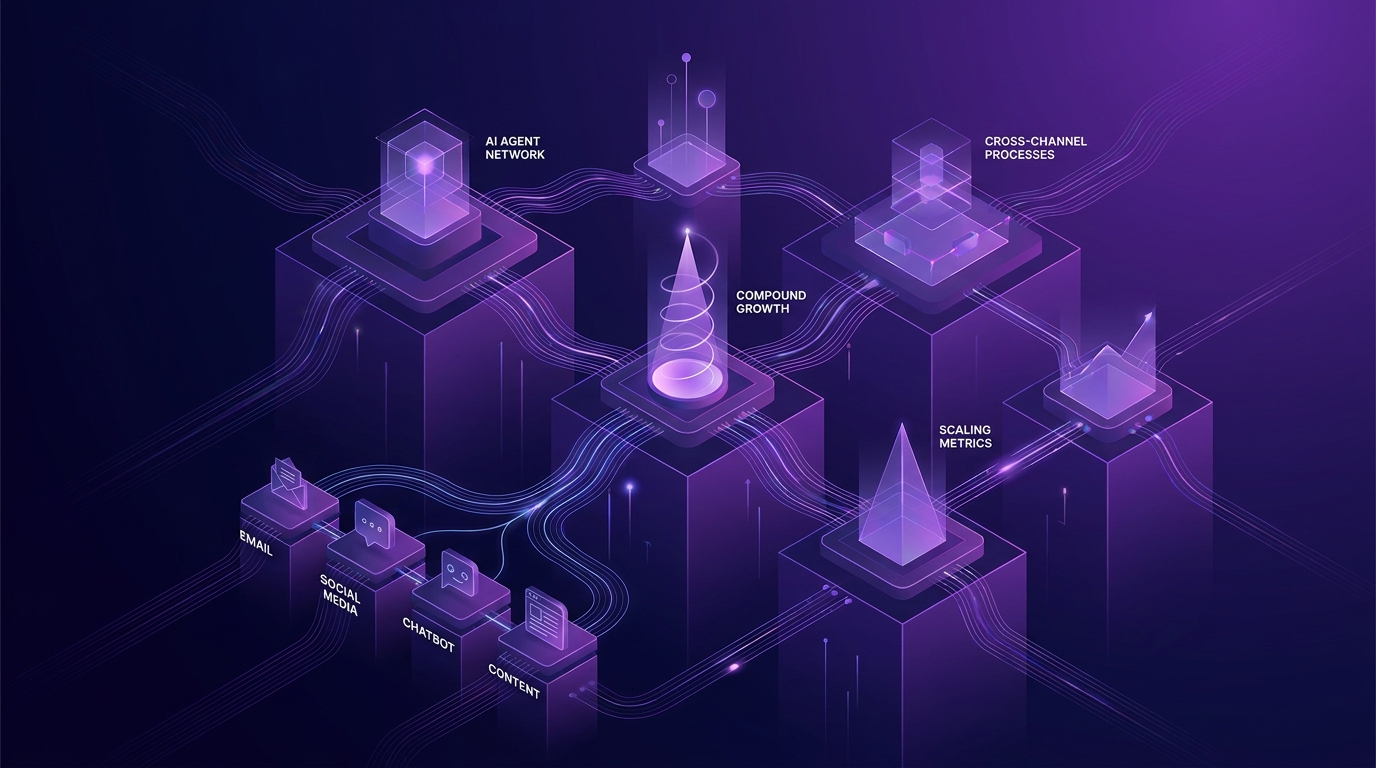
The highest-performing marketing operations in 2026 aren't running four isolated agents — they're running four interconnected agents that pass signals to each other through a shared intelligence layer. This orchestration model is where compound campaign lift is generated. When a paid media agent detects that a particular audience segment is converting at 3x the baseline, that signal should automatically inform the SEO agent to prioritize content for related intent clusters, the email agent to build a targeted nurture sequence for that segment, and the social agent to amplify organic posts featuring similar messaging.
Teams that have implemented this coordinated architecture report conversion rate improvements of 28–41% over siloed channel management, according to internal performance data from enterprise marketing platforms tracked in early 2026. The integration layer — whether a native orchestration tool or a custom API framework — is often the differentiating investment, not the individual agents themselves.
For teams just beginning this transition, the recommended sequencing is: deploy the paid media agent first (fastest ROI, clearest feedback loops), then SEO, then email, then social. Each successive deployment becomes easier because the data infrastructure built for the first agent accelerates onboarding of every subsequent one. Resist the temptation to launch all four simultaneously — agent coordination requires a stable data foundation, and rushing the architecture creates compounding errors downstream.
The future of channel-specialist AI is cross-agent learning: systems where the SEO agent's ranking signals directly influence the email agent's content personalization, and where social sentiment data feeds back into paid creative strategy in real time. That feedback architecture is already live in leading enterprise stacks and will become table-stakes for mid-market teams within 18 months.
Frequently Asked Questions
What are the main types of AI marketing agents by channel?
The four primary channel-specialist AI marketing agent types are SEO agents, paid media agents, email agents, and social media agents. Each is built with domain-specific logic, training data, and optimization cadences that match the unique mechanics of its channel. Generalist agents that attempt to serve all channels simultaneously typically underperform against these specialists on core metrics like ROAS, organic ranking velocity, and email deliverability.
Which AI marketing agent type should I deploy first?
Paid media agents typically deliver the fastest measurable ROI because they operate on short feedback loops — bid changes and budget reallocations produce visible results within days, not months. Start with paid media to build the data infrastructure and internal confidence needed to expand to SEO, email, and social agents sequentially. This staged deployment approach reduces integration errors and accelerates time-to-value across the full agent stack.
Can AI marketing agents from different channels work together?
Yes — and cross-channel signal sharing is where the largest performance gains are realized. When paid, SEO, email, and social agents share a common data layer, high-converting audience signals from one channel can immediately inform creative, content, and targeting decisions in others. This orchestrated architecture requires either a purpose-built orchestration platform or a custom integration layer, but teams that implement it consistently report conversion lifts of 28–41% over siloed deployments.
Are social media AI agents safe to run autonomously?
Social agents require more human oversight than paid or email agents due to the real-time, context-sensitive nature of social publishing. Best practice in 2026 is to run social agents with a brand safety layer that checks scheduled content against live news feeds before any post goes live. Fully autonomous publishing without guardrails creates meaningful brand risk — the goal is intelligent automation with defined human escalation triggers, not unchecked autonomy.