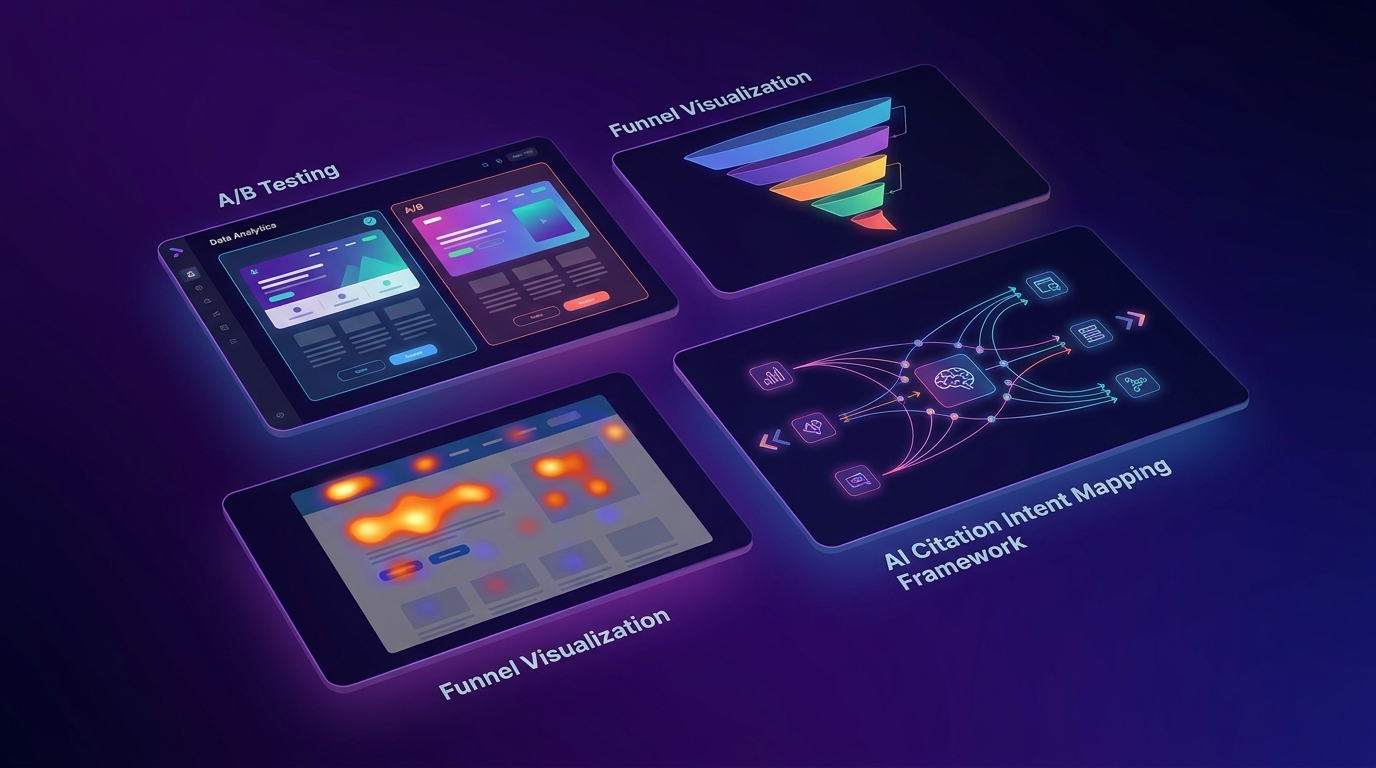
AI citation intent mapping is the practice of decoding the specific query context that brought a visitor to your page from an AI engine — and using that signal to deliver a precisely matched experience before they scroll past your headline. When a visitor arrives via ChatGPT, Perplexity, or Gemini, the citation that sent them carries a fingerprint of intent that traditional UTM parameters and keyword data simply cannot replicate. Master this framework and you can align landing page content, CTAs, and offers to the exact moment in the buyer journey your visitor is living right now.
Understanding AI Citation Intent Mapping and Why It Matters
Every time an AI engine like Perplexity or ChatGPT cites your content, it does so in response to a specific user query. That query has a precise meaning: the user was researching a comparison, validating a purchase decision, troubleshooting a problem, or exploring a concept for the first time. AI citation intent mapping is the discipline of reverse-engineering that query context so you can serve the visitor an experience that feels like a logical continuation of the conversation they were already having with the AI.
"Visitors arriving from AI citation links convert at rates up to 48% higher than organic search traffic — but only when the landing experience matches the intent embedded in the original query."
Traditional web analytics tells you a visitor came from a referral domain. Intent mapping tells you why they clicked. The gap between those two pieces of information is where conversion rates live. Brands that have invested in understanding their ai sourced leads conversion funnel report that mismatched landing experiences are the single largest source of drop-off among otherwise high-quality AI-referred visitors. Intent mapping closes that gap systematically.
Prerequisites: What You Need Before You Start
Before you begin building an intent map, you need the right infrastructure in place. Skipping this setup phase means your classification system will be working with incomplete or unreliable data, leading to personalization that misses the mark.
- Referrer tracking capability: Confirm your analytics platform captures HTTP referrer strings from AI engines. Perplexity, ChatGPT, and Gemini each send identifiable referrer headers. Verify these are being logged at the session level, not just the page level.
- URL parameter schema: Establish a consistent UTM or custom parameter convention for AI traffic. Use
utm_source=ai-citationandutm_contentto encode the citation topic cluster where possible. - Content inventory with intent tags: Audit your existing pages and tag each with a primary intent category (informational, navigational, commercial, transactional). This baseline makes later mapping faster.
- A/B testing or personalization tool: You will need the ability to serve different headline, hero copy, or CTA variants based on session-level signals. Tools like VWO, Optimizely, or even a lightweight JavaScript snippet can work.
- Minimum traffic threshold: Aim for at least 200 AI-referred sessions per month before attempting segmented personalization. Below that threshold, statistical noise will dominate your results.
Once these five elements are confirmed, you are ready to begin the step-by-step mapping process.
Step 1 — Capture AI Referral Data at the Source
The mapping process starts at the moment of arrival. You cannot personalize what you cannot identify, so precise capture is the non-negotiable foundation.
- Identify AI engine referrer patterns: Log referrers from
perplexity.ai,chat.openai.com,gemini.google.com,copilot.microsoft.com, and emerging engines. Create a dedicated AI referrer segment in Google Analytics 4 or your analytics platform. - Store the full referrer URL: The path component of the Perplexity referrer, for example, often contains the search thread topic. Capture and store this string in a custom dimension.
- Implement session storage flags: On the first page load for an AI-referred session, write a flag to session storage (e.g.,
ai_referral: trueandai_source: perplexity). This flag persists across page views within the session and enables multi-page personalization. - Build a real-time referrer lookup table: Maintain a simple lookup that maps known AI referrer domains to engine names and confidence scores for subsequent enrichment.
- Validate with server-side logging: Client-side capture can be blocked by browsers or extensions. Mirror your referrer capture server-side where possible to ensure complete data.
At the end of this step, every AI-referred session should be flagged, sourced, and stored with enough metadata to support classification in the next step.
Step 2 — Classify Intent Signals from Citation Context
With capture in place, the next task is to infer intent from the available context. Even when you cannot see the exact query, multiple proxy signals reveal what the visitor was trying to accomplish.
- Analyze the cited page topic: The page that was cited gives you a topic cluster. A citation on your comparison article signals commercial investigation intent. A citation on your tutorial signals informational intent at an early or mid-funnel stage.
- Parse referrer path keywords: Perplexity referrer URLs frequently include query fragments. Extract noun phrases and classify them against a taxonomy: problem-aware, solution-aware, product-aware, or decision-ready.
- Apply time-on-site heuristics: Visitors who land, scroll past 60%, and return within 48 hours are exhibiting decision-stage behavior regardless of initial intent signals. Layer behavioral intent on top of referral intent.
- Use landing page as a fallback classifier: If referrer data is sparse, the specific landing page URL is still a strong proxy. A pricing page visitor from any AI engine is exhibiting transactional intent.
- Score each session with an intent confidence value: Assign 1–5 confidence scores to each classification. Low-confidence sessions default to a neutral, middle-funnel experience rather than a mis-targeted one.
"Intent classification from AI referral context achieves roughly 73% accuracy when combining referrer path analysis with landing page topic matching — without requiring any user input."
Step 3 — Map Intent Tiers to Funnel Stages
Classification means nothing without a clear bridge to your funnel architecture. This step translates intent signals into actionable funnel stage assignments that drive personalization decisions downstream.
| Intent Tier | Signal Characteristics | Funnel Stage | Primary Goal |
|---|---|---|---|
| Exploratory | "What is," "how does," "explained" queries; top-of-funnel topics cited | Awareness | Educate and capture email |
| Comparative | "vs," "best," "alternatives," "top tools" cited; comparison pages referenced | Consideration | Differentiate and build trust |
| Validating | Case study, review, or testimonial pages cited; "does X work" queries | Evaluation | Reduce risk perception |
| Decision-Ready | Pricing, demo, or trial pages cited; "pricing," "cost," "get started" signals | Decision | Remove friction and convert |
Each tier demands a fundamentally different content emphasis. A visitor in the Exploratory tier who lands on a pricing page needs a graceful education path, not a hard close. Understanding the full picture of your ai traffic conversion optimization strategy means aligning these tiers with your existing CRO stack rather than treating AI traffic as a separate system.
Step 4 — Personalize On-Page Experiences by Intent Tier
With intent tiers mapped, personalization becomes a structured execution problem rather than a guessing game. Each tier gets a defined content treatment applied dynamically at the session level.
- Exploratory tier: Swap the default hero CTA from "Start Free Trial" to "Read the Complete Guide." Surface a contextually relevant lead magnet or email capture within the first 400 pixels. Reduce pricing mentions above the fold.
- Comparative tier: Inject a comparison table or competitive differentiator block near the top of the page. Highlight third-party validation (G2 ratings, analyst quotes) prominently. Replace generic CTAs with "See How We Compare."
- Validating tier: Prioritize case study snippets, ROI statistics, and customer logos in the hero or first content block. Add a trust-bar component if not already present. CTA should read "See Customer Results" rather than a generic action.
- Decision-Ready tier: Eliminate distracting navigation or secondary offers. Amplify urgency signals (limited trial seats, onboarding availability). Use a direct CTA: "Start Your Trial Today" or "Talk to Sales Now."
- Fallback (unclassified) tier: Serve the standard page experience with a soft intent-detection mechanism — a single question overlay or progress bar that routes users to the appropriate content path based on their self-selected goal.
These changes should be implemented using your existing personalization or A/B testing tool, triggered by the session storage flag set in Step 1. No backend engineering is required for most implementations.
Step 5 — Test, Measure, and Iterate Your Intent Map
An intent map is a living model, not a one-time configuration. AI query patterns evolve as new topics emerge and as AI engines update their recommendation models. Systematic iteration keeps your personalization accurate and your conversion rates improving.
- Run holdout tests by tier: For each intent tier, serve 20% of sessions the unmodified default experience. Compare conversion rates, bounce rates, and session depth against the personalized variant weekly.
- Audit citation topics monthly: Review which of your pages are being cited by AI engines and for what query types. New citation patterns signal new intent clusters that may not fit your existing tier taxonomy.
- Track micro-conversion events by tier: Beyond primary CTA clicks, track scroll depth, internal link clicks, and video plays segmented by intent tier. These micro-conversions reveal whether your content treatment is resonating at each stage.
- Refine classification confidence thresholds: If low-confidence sessions are underperforming, raise the threshold that triggers personalization. It is better to serve the neutral default than a confidently wrong experience.
- Document tier performance in a shared dashboard: Create a single-view dashboard that shows tier distribution, session volume, and conversion rate by tier for every AI engine. This makes reporting stakeholder-friendly and identifies improvement priorities immediately.
"Teams that iterate their intent maps on a monthly cadence report 22% higher AI-referred revenue after six months compared to teams that configure and forget."
Common Mistakes to Avoid
Even well-resourced teams fall into predictable traps when implementing AI citation intent mapping for the first time. These are the errors most likely to undermine your results.
- Treating all AI traffic as a single segment: ChatGPT users skew toward research and exploration. Perplexity users often exhibit stronger commercial intent. Grouping all AI engines into one bucket loses the nuance that drives personalization accuracy.
- Over-personalizing low-confidence sessions: Applying aggressive intent-based treatments to sessions you are not confident about produces worse outcomes than the default experience. Always honor your confidence score thresholds.
- Ignoring mobile rendering of personalized elements: Dynamically injected comparison tables or trust bars frequently break on mobile viewports. Test every intent tier treatment on mobile before launch.
- Failing to update the intent map after content changes: If you publish a new cornerstone article that begins attracting AI citations, it needs to be tagged and mapped immediately. Stale intent maps silently degrade over time.
- Measuring only last-click conversions: AI-referred visitors often convert on a return visit. Attribution models that only credit last-click will undervalue your intent mapping work and lead to incorrect resource allocation decisions.
Expected Results and Timeline
Results from AI citation intent mapping are not instantaneous, but the trajectory is consistent across implementations. Here is a realistic timeline based on current benchmarks across B2B and B2C deployments in 2026.
- Weeks 1–2: Infrastructure setup and data capture validation. No personalization live yet, but you will see AI referral segments appearing in your analytics with enough granularity to begin classification.
- Weeks 3–4: Intent classification taxonomy built and initial tier assignments made. First personalization variants deployed for Exploratory and Decision-Ready tiers only (highest-volume and highest-value respectively).
- Month 2: All four tiers live. Early holdout data will show conversion rate deltas. Expect 10–18% lift in primary CTA clicks from Decision-Ready tier sessions as a realistic early benchmark.
- Month 3: Comparative and Validating tier performance stabilizes. Teams typically see a 15–25% improvement in overall AI-referred conversion rate versus the pre-mapping baseline.
- Months 4–6: With monthly iteration cadence in place, compounding improvements accumulate. Teams with mature intent maps and clean attribution see 30–45% higher conversion rates from AI-referred traffic compared to their organic search traffic baselines — consistent with the broader findings on ai traffic conversion optimization performance.
The investment in this framework pays forward. As AI-driven discovery continues to grow as a primary acquisition channel through 2026 and beyond, every improvement to your intent mapping infrastructure compounds in value.
Frequently Asked Questions
What is AI citation intent mapping and how is it different from keyword intent analysis?
AI citation intent mapping is the process of inferring a visitor's goal from the AI engine query context that generated the citation bringing them to your page. Traditional keyword intent analysis classifies queries typed into Google by their likely purpose. AI citation intent mapping goes further by incorporating the conversational context of the AI interaction — including the phrasing of the question, the topic cluster of the cited page, and behavioral signals — to produce a more precise funnel stage assignment. The result is a richer intent signal that enables more accurate personalization than keyword classification alone provides.
How do I know which AI engine sent a visitor to my site?
Each major AI engine sends identifiable HTTP referrer headers. Visitors from Perplexity carry a referrer of perplexity.ai, ChatGPT sends chat.openai.com, and Google Gemini sends gemini.google.com. You can capture these referrer values in your analytics platform by creating a custom referrer-based segment or dimension. Some engines also append query-related path fragments to their referrer URLs, which provide additional intent context beyond just the engine name.
Do I need expensive personalization software to implement intent-based experiences?
No. Basic intent-based personalization can be implemented with a lightweight JavaScript snippet that reads session storage flags and swaps text, CTA copy, or content blocks on page load. More sophisticated dynamic treatments benefit from dedicated tools like Optimizely or VWO, but the classification logic itself requires nothing more than JavaScript and a reliable referrer capture mechanism. Start simple — swap one CTA per tier — and invest in more capable tooling only after validating that the intent model is accurate.
How much AI-referred traffic do I need before intent mapping is worth doing?
A practical minimum is 200 AI-referred sessions per month to generate statistically meaningful personalization test results. Below that volume, the noise in your conversion rate data will make it impossible to distinguish genuine lift from random variance. If your current AI referral volume is below this threshold, focus first on improving your AI citation footprint — creating structured, citable content that AI engines reference frequently — before investing heavily in the personalization layer.
Can intent mapping work for e-commerce sites, or is it only for B2B?
Intent mapping works effectively for both e-commerce and B2B contexts, though the tier definitions differ. E-commerce implementations typically compress the funnel into two or three tiers (discovery, consideration, purchase-ready) and focus personalization on product recommendation modules, urgency signals, and social proof placement. B2B implementations tend to use four to five tiers with heavier emphasis on trust-building content and lead capture optimization. The underlying framework — capture, classify, map, personalize, iterate — applies equally to both contexts.
How often should I update my AI citation intent map?
A monthly audit cadence is the recommended minimum for most sites. AI engines update their recommendation models frequently, and the query contexts in which your pages get cited can shift meaningfully within a few weeks. Monthly reviews of your AI referral segment data, combined with a quarterly deep-dive into classification accuracy and tier distribution, will keep your intent map calibrated. Sites with high AI referral volume — more than 2,000 sessions per month — benefit from bi-weekly reviews to catch emerging citation patterns before they produce large volumes of mis-targeted experiences.