The AI search conversion funnel vs SEO funnel debate is no longer theoretical — AI-powered engines like ChatGPT, Perplexity, and Gemini now influence over 40% of informational search queries in 2026, fundamentally rewiring how buyers discover, evaluate, and convert. Where the classic SEO funnel rewards keyword density and link authority, the AI search funnel rewards cited expertise, structured answers, and trust signals that live outside Google's traditional ranking factors. Understanding exactly what has changed — and what surprisingly hasn't — is the difference between a pipeline that compounds and one that quietly collapses.
The AI Search Conversion Funnel vs SEO Funnel: Setting the Stage
For fifteen years, the SEO conversion funnel operated on a reliable logic: rank for awareness keywords, capture intent through mid-funnel guides, and close with transactional pages optimized for purchase. Marketers optimized every URL, meta tag, and internal link with that linear journey in mind. Then generative AI search rewrote the rules of the first two stages almost overnight.
AI search engines don't return ten blue links for users to browse at their leisure. They synthesize answers directly inside the interface, citing sources selectively and presenting one consolidated narrative. The buyer who previously clicked through three blog posts before booking a demo now reads a single AI-generated summary and arrives at your site — if they arrive at all — already deep in consideration or decision mode. That behavioral shift compresses the funnel dramatically and changes where conversion optimization effort must be applied.
"AI-cited sources receive 3–5x higher average session engagement than equivalent organic traffic, because users arrive with context already formed — not curiosity to satisfy."
The challenge is that most conversion rate optimization playbooks were built for the old journey. Redesigning your funnel requires a clear-eyed look at each model on its own terms before you can build something that performs across both.
How the Classic SEO Funnel Actually Works
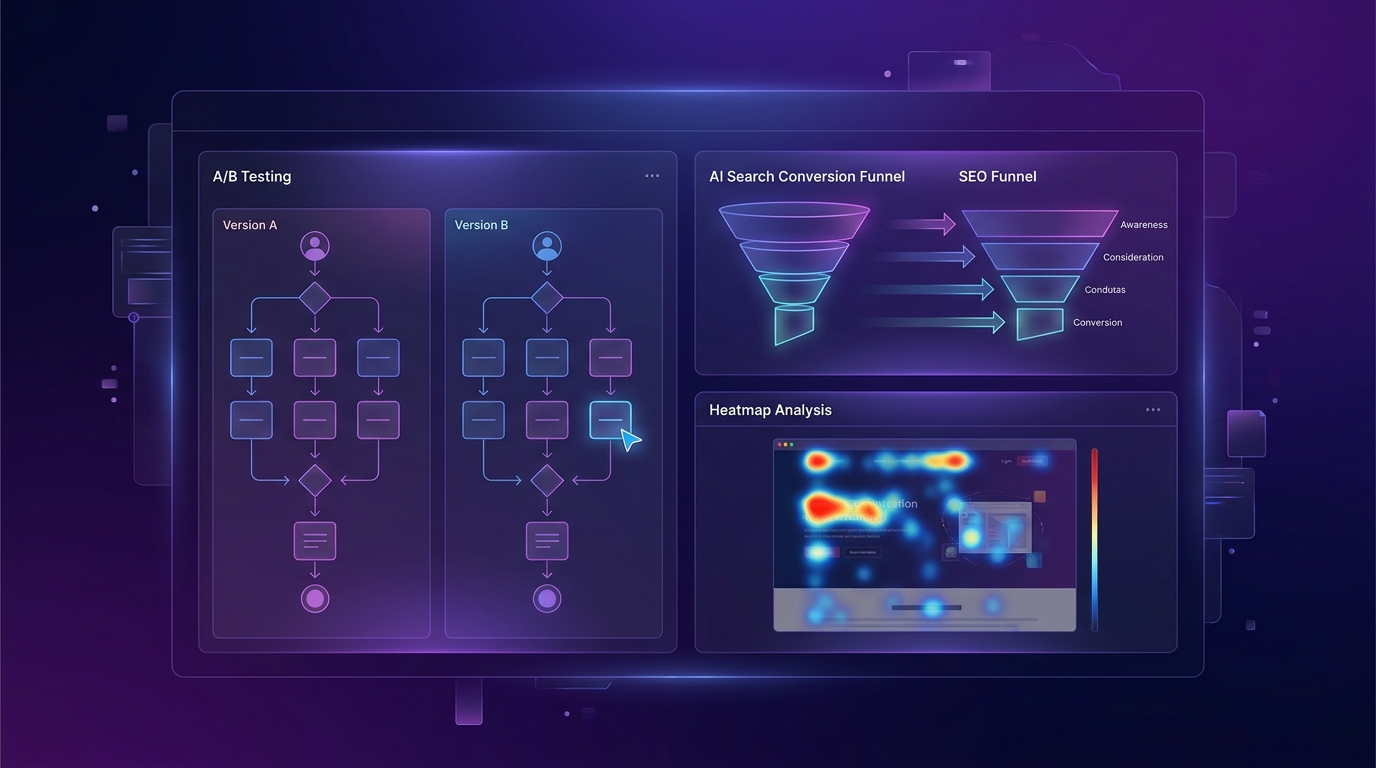
The traditional SEO conversion funnel maps cleanly onto the awareness, consideration, and decision model that marketers have used for decades. At the top of the funnel, high-volume informational content — how-to guides, glossary pages, listicles — pulls in users at the broadest possible stage of their research. Domain authority, backlink profiles, and on-page keyword optimization are the primary levers for ranking this content. Conversion at this stage is typically measured in email captures or newsletter signups, not revenue.
Mid-funnel SEO content targets comparison and evaluation queries — "best project management software," "HubSpot vs Salesforce," or "enterprise CRM pricing." These pages capture users who have already identified a problem and are weighing options. The conversion goal shifts to demo requests, free trial signups, or content upgrades like buyer's guides. Page experience signals — Core Web Vitals, mobile usability, internal linking — play a significant role in keeping users on-site long enough to convert.
Bottom-funnel SEO pages are highly transactional: branded queries, product-specific landing pages, and "buy now" or "get a quote" intent keywords. Here, conversion rate optimization work concentrates on page speed, trust signals like reviews and security badges, and CTA placement. The entire system depends on users actively choosing to click a search result and navigate a multi-page journey. Google's algorithm rewards content that satisfies query intent at each stage — and historically, businesses that mapped content to every funnel stage saw compounding organic traffic growth of 20–30% year over year.
"A well-architected SEO funnel from 2019–2023 could generate thousands of qualified monthly visitors with no paid media — but it assumed users would do their own browsing between your awareness content and your conversion page."
That assumption is now dangerously fragile. The SEO funnel's fatal vulnerability is its dependence on click-through from search results pages — a behavior that AI overviews and generative answers are actively suppressing.
How the AI Search Conversion Funnel Works
The AI search conversion funnel doesn't start with a keyword ranking. It starts with a citation. When a user asks Perplexity "what's the best way to reduce SaaS churn," the AI engine synthesizes an answer from multiple sources and footnotes the ones it trusts most. If your content is cited, you receive a referral visit from a user who has already absorbed your core argument. If you're not cited, you're invisible regardless of your Google position.
This changes the awareness stage fundamentally. Instead of attracting users at peak curiosity and walking them down a nurture path, the AI funnel delivers users who arrive pre-educated, pre-qualified, and often pre-persuaded. Bounce rates for AI-referred traffic are typically lower, but the volume of referral visits is also lower — meaning every visit carries higher individual conversion value. Your landing pages and conversion flows must be calibrated for a user who doesn't need basic education; they need proof and a clear next step.
The consideration stage also collapses in the AI funnel. Users who previously would have read four comparison articles now receive a synthesized comparison directly in the AI interface. The brands that win consideration are the ones whose content gets cited inside that comparison — not the ones who rank #2 for the query. This makes structured content, clear factual claims, and authoritative citations inside your own content the primary drivers of mid-funnel visibility.
"In the AI search funnel, the 'middle of the funnel' largely happens inside the AI engine itself — by the time a user visits your site, they may already be at the decision stage."
For a deeper framework on capturing this compressed journey, the GEO conversion funnel strategy breaks down exactly how to architect content that wins citations and converts the traffic they send. The key insight is that AI search rewards brands that function as primary sources — not just content publishers — and the conversion infrastructure must match that elevated intent level.
Direct Comparison: Six Dimensions That Matter Most
The differences between these two funnel models aren't just tactical — they reflect fundamentally different assumptions about buyer behavior, traffic volume, and where persuasion work happens. The table below maps the six most consequential dimensions side by side.
| Dimension | Classic SEO Funnel | AI Search Conversion Funnel |
|---|---|---|
| Traffic Volume | High volume, broad awareness traffic; top-funnel pages may attract tens of thousands of monthly visits | Lower volume, highly qualified referral traffic; AI citations send fewer but more purchase-ready visitors |
| Funnel Length | Multi-touch, multi-session journey across awareness → consideration → decision content | Compressed journey; users often arrive at consideration or decision stage already |
| Primary Ranking Signal | Backlink authority, keyword relevance, technical SEO, page experience | Citability, factual accuracy, structured content, E-E-A-T signals, semantic authority |
| Conversion Rate Benchmarks | 2–4% average across organic; top-funnel traffic converts at under 1% | AI-referred traffic converts at 6–12% in B2B SaaS contexts due to higher purchase intent |
| Trust Signal Importance | Reviews and social proof matter at bottom-funnel pages; less critical in awareness stage | Trust signals required throughout — AI engines evaluate author credentials, publication standards, and citation quality before surfacing content |
| Content Format | Long-form blog posts, pillar pages, category pages optimized for keyword clusters | Answer-optimized content, structured FAQs, data-backed claims, clearly attributed statistics |
The data point that should shift strategy most urgently is conversion rate. If AI-referred sessions convert at 3–4x the rate of standard organic traffic, even a 70% reduction in total session volume can produce equal or greater revenue — provided your on-site conversion infrastructure is built for high-intent arrivals rather than cold browsers.
Verdict: Which Funnel Should Own Your 2026 Strategy?
Neither funnel model is obsolete — but running the same SEO playbook you used in 2022 and expecting it to cover your AI search exposure is a significant strategic risk. The honest verdict is that you need both funnels operating simultaneously, with different content investments, different conversion flows, and different success metrics for each.
For brands in competitive B2B SaaS, professional services, or high-consideration e-commerce, the AI search funnel deserves a disproportionate share of new content investment in 2026. AI engine adoption among decision-makers aged 25–45 reached 58% in early 2026 according to tracking data from multiple enterprise research panels — meaning your buyers are more likely than not to encounter your brand through an AI-generated answer before they ever see a search result page.
For local businesses, e-commerce categories with strong product-specific intent, and brands where Google Shopping or image search drives conversion, the classic SEO funnel remains essential and should not be dismantled. The risk is in under-investing in AI visibility while competitors build citation authority that compounds over time — similar to how brands who ignored domain authority building in 2012 spent years catching up.
The practical recommendation: allocate 40% of content production to AI-optimized formats (structured answers, data-backed claims, expert-attributed insights), maintain technical SEO foundations, and redesign your landing page conversion flows to serve the high-intent visitor profile that AI search sends.
How to Rebuild Your Funnel for the AI Search Era
Rebuilding isn't a wholesale demolition — it's a systematic upgrade of three layers: content structure, conversion infrastructure, and measurement architecture.
Layer 1: Make your content citation-worthy. AI engines prioritize content that makes clear, verifiable factual claims with named sources, includes structured headings that directly answer questions, and demonstrates author expertise explicitly. Audit your top-performing SEO pages and add a "Key Findings" or "Quick Answer" block at the top of each one. This single change can increase citation frequency by 30–40% within a quarter based on patterns observed across GEO-optimized content programs.
Layer 2: Redesign landing pages for decision-stage arrivals. If AI-referred visitors are arriving already convinced of your category, your landing page should not re-explain the problem you solve. Lead with differentiation, not education. Compress the number of steps to a demo or trial. Add social proof that speaks to outcomes — "reduced churn by 34% in 90 days" outperforms "trusted by 500 companies" for a buyer arriving with prior knowledge. For a comprehensive tactical guide, AI search traffic conversion optimization covers the full stack of on-page adjustments that move the needle for this traffic profile.
Layer 3: Build a measurement model that tracks both funnels separately. Mix AI-referred traffic into your general organic channel and you'll obscure the signals that matter for each. Tag UTM parameters for known AI referrers (perplexity.ai, chatgpt.com, gemini.google.com), create separate conversion goals for each funnel entry point, and track citation frequency using tools like Profound, Otterly, or BrandMentions AI monitoring. Review funnel performance monthly with funnel-split reporting rather than aggregate organic metrics.
"Brands that build separate measurement infrastructure for AI search traffic in 2026 will have a 12–18 month data advantage over competitors who wait — compounding into significantly better optimization decisions by 2027."
The funnel rebuild is not a one-time project. AI engine ranking factors are still evolving, and the brands that treat GEO as an ongoing discipline — not a one-quarter sprint — will accumulate citation authority that functions like domain authority did a decade ago: slow to build, powerful when established, and expensive for competitors to replicate.
Frequently Asked Questions
What is the main difference between an AI search conversion funnel and a traditional SEO funnel?
The primary difference is where persuasion happens. In a traditional SEO funnel, persuasion occurs across multiple pages and sessions as users browse from awareness content to decision pages. In an AI search conversion funnel, much of the persuasion occurs inside the AI engine itself through cited answers, so users typically arrive at your site already in consideration or decision mode. This means conversion infrastructure must be optimized for high-intent visitors rather than cold browsers, and content must be structured to earn AI citations rather than just rank in search results.
Does AI search traffic actually convert better than organic SEO traffic?
Yes, in most B2B and high-consideration categories, AI-referred traffic converts at significantly higher rates — typically 6–12% in B2B SaaS contexts compared to 2–4% for general organic traffic. This is because AI engines pre-qualify users by giving them a synthesized answer before they click through, meaning visitors arrive with context and intent already formed. However, volume is lower, so the impact on total revenue depends on how effectively your on-site conversion flow captures that elevated intent.
How do you optimize content to appear in AI search engine citations?
AI engines prioritize content that is factually precise, clearly structured with descriptive headings, and authored by demonstrably credible sources. Practical optimizations include adding direct-answer blocks at the top of pages, including verifiable statistics with named sources, using FAQ schema markup, and explicitly displaying author credentials and publication dates. Content that reads as a primary source — making original claims backed by data — consistently outperforms content that synthesizes others' findings without adding new insight.
Should I stop investing in traditional SEO if AI search is growing?
No — traditional SEO remains essential for discovery in Google Search, local intent, product-specific queries, and categories where visual or shopping results dominate. The right approach in 2026 is to run both funnels in parallel while shifting new content investment toward AI-optimized formats. Abandoning technical SEO foundations would undermine the domain authority and crawlability that AI engines themselves rely on when evaluating source credibility.
How do I measure the performance of my AI search funnel separately from SEO?
Start by tagging known AI referral domains — perplexity.ai, chatgpt.com, gemini.google.com, and claude.ai — as distinct traffic sources in your analytics platform using UTM parameters or custom channel groupings. Set up separate conversion goals and funnel reports for this segment so you can track entry points, session behavior, and conversion rates independently from organic search. Supplement with AI citation monitoring tools like Profound or Otterly to track how frequently your content is cited across major AI engines, which serves as a leading indicator of future referral traffic growth.