A well-executed informational page CTA strategy is the difference between a content library that educates and one that actually grows your business — matching every offer to where the reader stands in the funnel without triggering the skepticism that kills trust on knowledge-first pages. Most CRO guides treat all CTAs the same, but informational content operates under entirely different psychological rules: readers came to learn, not to buy, and the moment your call-to-action feels out of place, they leave. This pillar covers the frameworks, placement logic, format selection, and trust mechanics that make informational page CTAs convert without burning reader goodwill.
What Is an Informational Page CTA Strategy?
An informational page CTA strategy is a systematic approach to designing, placing, and testing calls-to-action on content whose primary purpose is to answer questions, explain concepts, or educate an audience — rather than to sell directly. These pages include how-to guides, explainer articles, glossary entries, comparison posts, and long-form tutorials. They attract readers who are in the awareness or consideration stage of the buyer journey, which means the CTA cannot behave the same way it would on a product or pricing page.
The strategy encompasses four interconnected decisions: what offer to present, how to phrase the CTA copy, where to place it within the page, and what trust signals must surround it. Get any one of these wrong on an informational page and you don't just lose the conversion — you damage the credibility that made the reader trust the content in the first place. That compounding cost is why informational CTAs deserve their own dedicated framework rather than a copy-paste from your transactional pages.
"Pages built to inform generate some of the highest organic traffic volumes in a site — yet they are routinely the lowest-converting assets because the CTA strategy was designed for a different reader mindset entirely."
A mature informational page CTA strategy distinguishes between at least three intent tiers: early-stage readers who want to understand a concept, mid-funnel readers who are comparing solutions, and late-funnel readers who reached an informational page while vetting a specific vendor. Each tier warrants a distinct offer type, CTA format, and placement logic. Collapsing all three into a single "book a demo" button is one of the most common — and most costly — CRO mistakes in B2B and B2C content programs alike.
Why Intent Alignment Changes Everything on Informational Pages
Intent mismatch is the single biggest conversion killer on informational content. When a reader lands on a page to understand how something works and the first prominent CTA pushes them to start a free trial, the cognitive dissonance registers immediately — and most readers resolve it by ignoring the CTA or leaving. The page may still rank well and drive traffic, but it produces almost no downstream pipeline because the offer never matched the mindset.
Intent alignment works in the opposite direction too. When the CTA feels like a natural next step — a checklist that extends the article's value, a template that operationalises the concept just explained, or a guide that goes one level deeper — readers often click without any hard sell at all. The offer functions as content, not interruption. Industry observations from practitioners running large-scale content programs suggest that intent-matched CTAs on informational pages can generate click-through rates two to four times higher than generic product-focused CTAs placed on the same pages.
This is the foundation behind informational content conversion optimization — a discipline that treats the conversion path on educational pages as fundamentally different from the path on commercial or transactional pages. The value exchange must be proportional to where the reader sits in their decision journey.
"Readers on informational pages have a high tolerance for additional content and a low tolerance for premature selling — the fastest way to destroy trust is to ask for more commitment than the relationship has earned."
The stakes extend beyond individual conversion rates. Informational pages are typically a site's highest-traffic assets and the primary entry point for first impressions. Misaligned CTAs on those pages train readers — at scale — to ignore or distrust the brand's offers, creating a negative association that persists across subsequent visits. Protecting trust on informational pages is therefore a long-term brand asset, not just a short-term CRO concern.
Core Components of a High-Converting Informational CTA
Five elements determine whether an informational page CTA converts or collapses. Understanding each one independently — and how they interact — is the foundation for building a repeatable framework rather than guessing page by page.
1. Offer-to-Intent Match: The offer must serve the same question the page answers, just at the next level of depth or practicality. An article explaining the concept of conversion rate optimization should offer a CTA to a CRO audit template or a deeper guide, not a sales call. An article explaining which CRO tools exist might reasonably offer a free trial link because the reader is already further along in the funnel.
2. CTA Copy Framing: On informational pages, benefit-led copy that emphasises learning or doing consistently outperforms urgency-based or scarcity-based copy. "Download the implementation checklist" outperforms "Get 50% off — limited time" because it matches the reader's stated reason for being on the page.
3. Visual Weight and Format: Inline text CTAs, contextual callout boxes, and content upgrades tend to perform better on informational pages than full-width banners or exit-intent pop-ups that interrupt reading. The format should feel native to a reading experience, not bolted on from a product page template.
4. Placement Logic: Placement should reflect reading momentum. A CTA near the top of an informational page catches readers before they've received value; a CTA after a substantive section that just delivered insight catches readers at peak engagement. Multiple CTAs placed at logical rest points typically outperform a single CTA at the bottom that most readers never reach.
5. Surrounding Trust Signals: Social proof, author credentials, recency indicators, and privacy micro-copy near the CTA reduce the perceived risk of clicking. On informational pages, trust signals matter more than on product pages because the reader hasn't yet formed a commercial relationship with the brand — every friction point is magnified.
| CTA Element | Traditional Approach | Intent-Matched Modern Approach |
|---|---|---|
| Offer Type | Product demo or free trial on every page | Content upgrade, tool, or template matched to page topic and funnel stage |
| CTA Copy | Urgency-driven ("Act now", "Limited offer") | Benefit and learning-driven ("Get the framework", "See how it works") |
| Placement | Single CTA at page bottom or sticky header | Multiple contextual placements at peak-engagement moments |
| Format | Full-width banner or disruptive pop-up | Inline callout, content upgrade box, or in-article text link |
| Trust Signals | Star ratings from product reviews | Author expertise, recency, privacy assurance, no-spam copy |
| Testing Method | A/B test button colour | A/B and multivariate tests on offer type, copy, and placement simultaneously |
How to Implement an Intent-Matched CTA Framework
Implementation starts with auditing your existing informational pages and classifying each one by intent stage. Sort pages into three buckets: awareness (reader is learning what something is), consideration (reader is evaluating options or approaches), and decision-adjacent (reader is close to acting and vetting specifics). Each bucket maps to a default offer type and CTA format, which you then customise to the page's specific topic.
For awareness-stage pages, the default best-performing offer types are content upgrades (a downloadable version of the article, a related checklist, or a deeper guide), newsletter sign-ups framed around the topic, and free tools that let the reader apply what they just learned. The CTA copy should reference the concept just explained: if the page covers "how content audits work," the CTA might read "Use our free content audit template."
For consideration-stage pages, the offer can step up to webinars, case study collections, comparison tools, or email courses. These readers are actively evaluating approaches and welcome structured help in making a decision. This is also where a soft product CTA — framed as "see how [product] handles this" rather than "buy now" — starts to become acceptable because the reader's intent is closer to commercial.
For decision-adjacent informational pages, a free trial, demo request, or consultation offer is appropriate — but should appear alongside content-value CTAs rather than replacing them. Many late-funnel readers still appreciate the option to consume more content before committing, and giving them both paths consistently outperforms forcing them toward a single high-commitment action.
Placement within the page should follow a three-point structure: one CTA after the introduction (for readers who already know what they want and are confirming fit), one CTA after the most substantive section (peak engagement), and one CTA at the close of the article (for readers who read to the end and are therefore highly engaged). For deeper explorations of what actually moves the needle on placement, the CTA placement informational content testing methodology covers specific position tests and their outcomes in detail.
Finally, map each page's CTA offer back to the broader funnel — ensure that clicking the CTA delivers the promised value immediately and that the follow-up sequence maintains the educational tone rather than switching to aggressive sales messaging. A reader who clicks a "download the guide" CTA and immediately receives three sales emails has been deceived about the value exchange, and they will not return. For a full treatment of how to align offers across funnel stages, the intent matched offer strategy informational pages guide provides a detailed mapping framework.
Tools, Testing, and Measurement for Informational Page CTAs
Testing informational page CTAs requires different tooling priorities than testing product or landing pages. Because informational pages typically convert at lower absolute rates, you need either higher traffic volumes or longer testing windows to reach statistical significance — a common mistake is calling tests too early based on insufficient sample sizes and implementing changes that are actually noise.
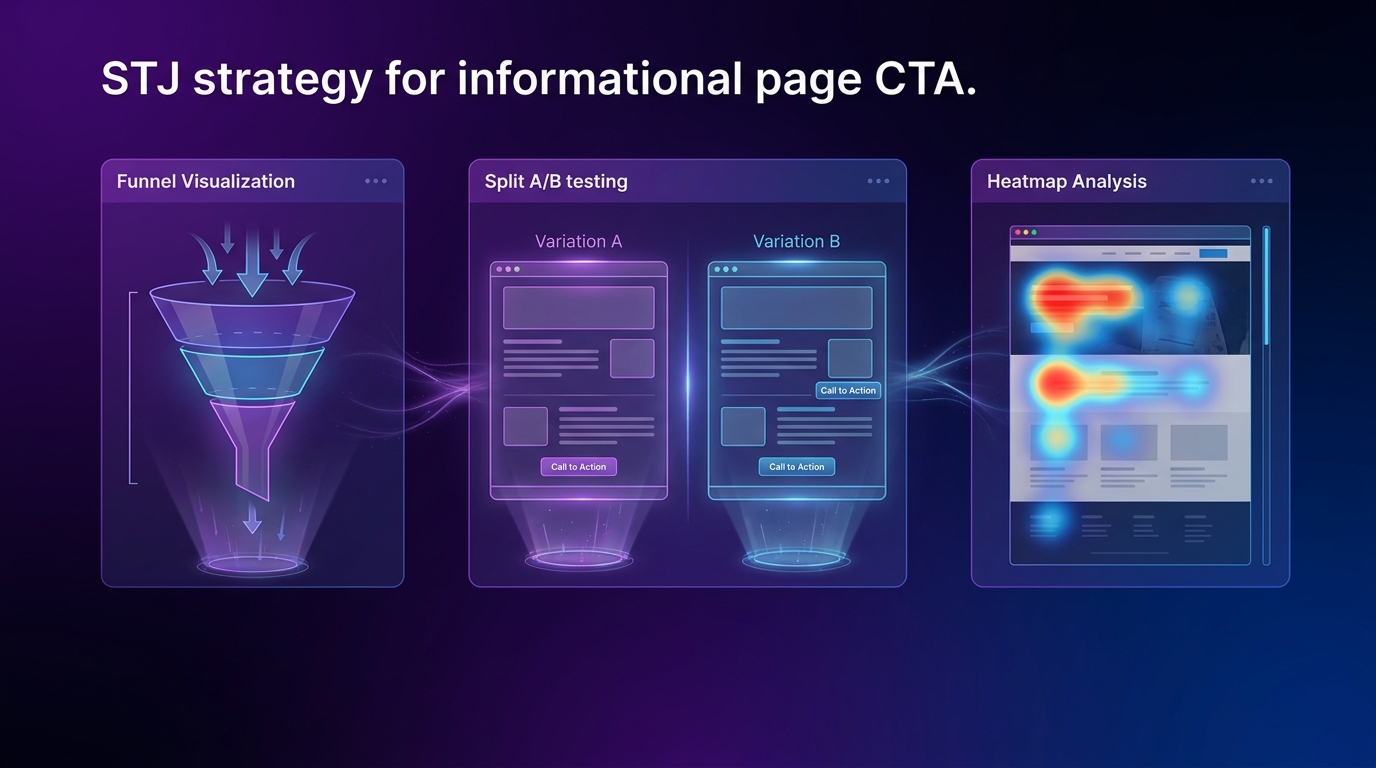
The core testing stack for most content-heavy sites combines: an A/B or multivariate testing platform (VWO, Convert, or Optimizely are widely used), a heatmap and session recording tool to understand reading behavior and scroll depth (Hotjar and Microsoft Clarity are popular options), and a tag management system to fire CTA impression and click events independently of conversion so you can calculate both click-through rate and downstream conversion rate separately.
Measuring informational page CTA performance requires a two-stage attribution model. The first stage is the on-page CTA click rate (impressions to clicks). The second stage is the downstream conversion rate of people who took the CTA action — did the email subscriber convert to a trial? Did the guide downloader request a demo within 30 days? Optimising only for on-page CTR without tracking downstream quality will push you toward low-commitment CTAs that generate email lists full of people who never convert to customers.
"The most useful metric for informational page CTAs is not click-through rate — it is the qualified pipeline generated by readers who engaged with a CTA offer three to six months after first visiting the page."
Many practitioners run a quarterly audit of their top twenty informational pages by traffic, benchmarking each page's CTA click rate against the site average and flagging outliers for investigation. Pages significantly below average often have misaligned offers; pages significantly above average contain CTA patterns worth replicating across the content program. This systematic review approach consistently surfaces more actionable insights than one-off page-level tests.
Common Mistakes, Future Outlook, and What Comes Next
The most common mistakes in informational page CTA strategy cluster into four patterns. First, applying a single CTA template site-wide regardless of page topic or funnel stage — this is the fastest way to make every page feel like a product brochure. Second, using urgency or scarcity language on informational pages where no genuine scarcity exists — readers on knowledge-first pages are more likely to perceive this as manipulation rather than motivation. Third, placing all CTAs below the fold on long-form pages, where scroll depth data consistently shows significant reader drop-off before the end. Fourth, neglecting mobile-specific CTA formats — on mobile, large inline banners that interrupt text flow generate significantly higher dismissal rates than compact contextual callouts.
A subtler but equally damaging mistake is mismatching the post-click experience. If the CTA promises "the complete guide" and the reader lands on a generic landing page asking them to fill out a ten-field form to receive a PDF, the trust built by the informational content is immediately spent. The post-click journey should feel like a continuation of the content experience, not a pivot into a sales funnel.
Looking forward, the shift toward AI-generated answers in search results is changing the traffic composition of informational pages. Readers who arrive via AI-assisted search have often already consumed a summary answer and are visiting the page for depth, verification, or a specific next step — which means their intent is slightly more advanced than the traditional top-of-funnel informational reader. This shift favors consideration-stage and decision-adjacent CTAs on pages that previously served pure awareness traffic, and it rewards content programs that can distinguish between these two reader profiles through behavioral signals like time-on-page, scroll depth, and return visit frequency.
The future of informational page CTA strategy also runs through personalization — specifically, serving different CTA offers to first-time visitors versus returning readers, and to readers who arrived via branded search versus non-branded queries. As behavioral data tools become more accessible to mid-market content teams, the gap between static one-size-fits-all CTAs and dynamically intent-matched offers will widen, and sites still running uniform CTAs across their informational library will face compounding disadvantages in both conversion rate and content program ROI.
Frequently Asked Questions
What is the best type of CTA for an informational blog post?
The best CTA for an informational blog post is one that extends the value of what the reader just consumed — a relevant content upgrade, checklist, template, or deeper guide aligned to the page's specific topic. Generic product CTAs or free trial offers typically underperform on awareness-stage informational pages because they ask for more commitment than the relationship has earned. The offer should feel like a natural next step in the reader's learning journey, not an interruption from a separate sales channel.
How many CTAs should an informational page have?
Most informational pages perform well with two to three CTAs placed at strategic points: once after the introduction, once after the most substantive section, and once at the close. Having multiple CTAs is not the same as being aggressive — as long as each placement feels contextually appropriate and the offers are relevant, readers accept multiple CTAs without friction. What damages trust is repetition of the same hard-sell CTA throughout, not the presence of multiple well-placed offers.
How do you measure the success of a CTA on an informational page?
Success on informational page CTAs should be measured in two stages: the on-page click-through rate (what percentage of readers clicked the CTA) and the downstream conversion rate (what percentage of those readers eventually became qualified leads or customers). Optimising only for click-through rate can inflate low-quality sign-ups; tracking downstream outcomes over a 30-to-90-day window gives a more accurate picture of the CTA's actual business value. Setting up CTA impression and click events in your analytics or tag manager independently enables this two-stage attribution model.
Should informational pages ever use product-focused CTAs?
Yes, but the appropriateness depends on the intent stage of the page. Consideration-stage and decision-adjacent informational pages — pages where readers are actively comparing approaches or vetting specific solutions — can support soft product CTAs framed around exploration rather than purchase ("see how it works" rather than "buy now"). Pure awareness-stage pages, where the reader is still learning foundational concepts, should prioritise content-value offers and reserve any product reference for a secondary, lower-prominence CTA placement.
What CTA copy works best on informational content?
Benefit-led and learning-oriented copy consistently outperforms urgency-based or scarcity-based copy on informational pages. Phrases that reference what the reader will gain or be able to do — "download the framework," "get the step-by-step checklist," "see the full comparison" — align with the educational mindset readers bring to informational content. Avoid pressure language like "limited time" or "act now" unless a genuine and verifiable constraint exists, as readers in a learning mindset are particularly sensitive to perceived manipulation.
How does reader intent affect where to place a CTA on an informational page?
Reader intent influences both the vertical position and the format of the CTA. High-intent readers — those who arrived via branded or specific-solution queries — often respond to CTAs placed early in the page because they are already close to a decision. Low-intent readers need to consume value before a CTA feels relevant, so mid-page and end-of-article placements perform better for awareness-stage traffic. Heatmaps and scroll-depth data let you identify where specific page audiences disengage, which reveals the most effective CTA placement windows for that particular page's visitor profile.