
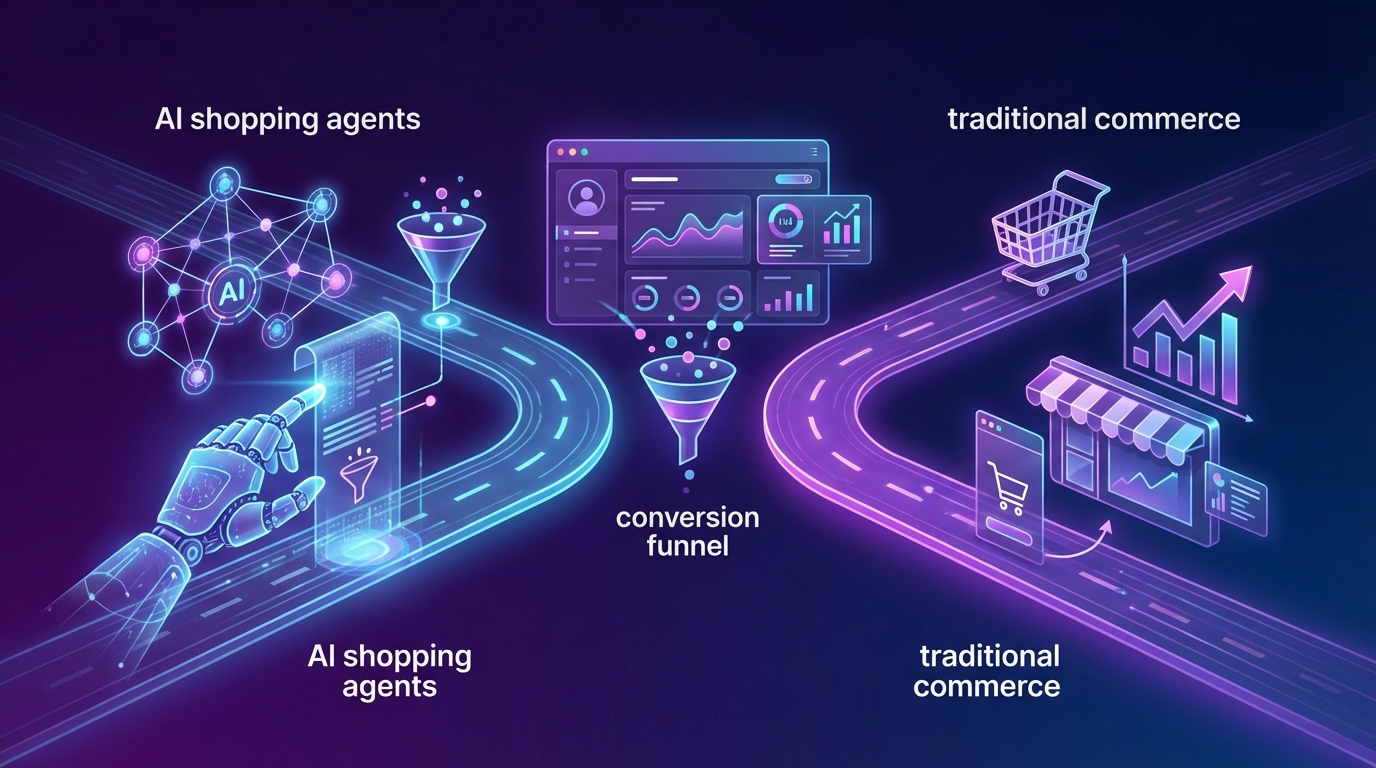
The battle between AI shopping agents vs traditional commerce is reshaping how merchants compete online in 2026, forcing a fundamental rethink of product discovery, pricing strategy, and customer acquisition. Where traditional search commerce rewarded whoever mastered Google rankings and paid ads, agentic commerce rewards whoever earns the trust of autonomous AI buyers operating on behalf of human shoppers. Understanding both models — and where they diverge — is now a survival skill for any serious e-commerce operator.
How AI Shopping Agents vs Traditional Commerce Stack Up
For the better part of two decades, e-commerce has operated on a predictable loop: a shopper types a query into a search engine, scans a results page, clicks through to a product listing, reads reviews, and either buys or bounces. Merchants who understood this loop invested in SEO, Google Shopping feeds, conversion rate optimization, and retargeting ads. The playbook was complex, but the mechanics were stable.
That loop is breaking. In 2026, a growing segment of online purchases are being initiated, evaluated, and completed by AI shopping agents — autonomous software systems that act on a user's behalf, often without the shopper ever visiting a merchant's website. Instead of optimizing a product page for a human eye, merchants now need to optimize for machine-readable signals that an AI agent will parse in milliseconds before deciding whether to include a product in its shortlist or dismiss it entirely.
"By 2026, industry projections suggest that 30% of consumers in developed markets will use some form of AI-assisted purchasing agent for routine buying decisions — up from near zero in 2023."
This shift is not marginal. It touches every stage of the purchase funnel: how products are discovered, how they are evaluated against competitors, how price sensitivity is interpreted, and how post-purchase loyalty is built. Before examining what merchants need to do differently, it is worth understanding each model on its own terms.
Traditional Search Commerce: How It Works for Merchants
Traditional search commerce centers on the relationship between a merchant's digital storefront and the search algorithms that determine its visibility. A shopper's intent is captured through a keyword, matched against an index of billions of pages, and surfaced as a ranked list. Merchants win by being at the top of that list — either organically through SEO or through paid placement via Google Shopping, Amazon Sponsored Products, or similar platforms.
The core levers merchants have controlled under this model include:
- Search engine optimization: Structured data markup, keyword-rich titles and descriptions, fast page load times, and mobile responsiveness all influence organic rank.
- Paid search and shopping ads: Cost-per-click bidding on branded and non-branded keywords drives immediate traffic to product and category pages.
- On-site conversion optimization: Once a visitor lands, product photography, social proof (reviews, ratings), scarcity signals, and checkout UX determine whether intent converts to revenue.
- Retargeting and email: Shoppers who browse without buying can be recaptured through display retargeting and abandoned-cart sequences.
This model has proven remarkably durable. In 2024, Google Shopping campaigns still drove an estimated 76% of all retail search ad spend in the United States. Amazon's search-first marketplace generated over $47 billion in advertising revenue in the same year, almost entirely from merchants competing for keyword-triggered visibility.
The human shopper remains central to every transaction in traditional search commerce. The merchant's job is to attract, persuade, and convert that human — influencing their emotions, addressing their objections, and making the path to purchase as frictionless as possible. Reviews, lifestyle imagery, and brand storytelling all serve a cognitively active buyer who makes the final call.
"In traditional search commerce, the product page is the sales floor. Every pixel is engineered to move a human from consideration to checkout."
The weaknesses of this model are also well-documented. Customer acquisition costs have risen sharply — Google Shopping CPCs increased by an average of 22% between 2021 and 2024. Click fraud, ad fatigue, and algorithm changes create constant revenue volatility. And as privacy regulations restrict third-party cookie tracking, the retargeting infrastructure that underpinned lower-funnel recovery is eroding. Traditional search commerce still works, but the margins are thinning and the skill requirements are expanding.
Agentic Commerce: How AI Shopping Agents Buy on Behalf of Humans
Agentic commerce inverts almost every assumption that traditional search commerce is built on. Instead of a human shopper navigating to a merchant's website and being persuaded by what they find there, an AI agent receives a directive — "find me the best wireless noise-cancelling headphones under $200 that ship within two days" — and autonomously executes the entire purchase workflow. The human never sees the product page. They may never visit the merchant's site at all.
These agents use several mechanisms to discover, evaluate, and transact with merchants:
- Structured data and product feeds: Agents query product data APIs, Google's Shopping Graph, and merchant-published structured data to build a candidate set. Incomplete or malformed product data means instant exclusion.
- Reputation and trust signals: Agents weight aggregate review scores, return policy clarity, verified seller badges, and merchant reliability metrics — all machine-readable signals rather than emotional appeals.
- Policy parsing: Return windows, shipping guarantees, and warranty terms are parsed automatically. A merchant with a vague or buried returns policy scores lower than a competitor whose policy is explicit and structured.
- Price and availability optimization: Agents compare real-time pricing across multiple merchants simultaneously, factoring in shipping costs, tax, and delivery speed to calculate a true landed cost.
- Checkout automation: Once a selection is made, agents complete checkout via stored credentials, one-click APIs, or platform-native purchasing flows — bypassing the persuasive elements of a merchant's cart page entirely.
"An AI shopping agent doesn't respond to urgency banners or lifestyle photography. It responds to data completeness, policy clarity, and trust signals it can verify programmatically."
The implications for merchant strategy are significant. Brand storytelling still matters — but it must be encoded in structured, machine-readable formats rather than visual design. A merchant's competitive advantage shifts from "best-looking product page" to "highest-quality product data and most trustworthy fulfillment record." Merchants who relied heavily on emotional conversion tactics — countdown timers, pop-up discounts, aggressive upsells — find those tools irrelevant when the buyer is an algorithm.
Agentic commerce also compresses the purchase funnel dramatically. In traditional search commerce, the average considered purchase involves 6–8 touchpoints before conversion. An AI agent can complete the equivalent research and decision in a single session, sometimes in under 30 seconds. The merchant who is not in the agent's data sources at the moment of query simply does not exist.
Head-to-Head Comparison: Six Dimensions That Matter
The differences between traditional search commerce and agentic commerce become starkest when mapped across the dimensions that directly affect merchant revenue and strategy. The table below distills the key contrasts across six critical areas.
| Dimension | Traditional Search Commerce | Agentic Commerce |
|---|---|---|
| Discovery mechanism | Keyword search → SERP ranking → human click | Agent query → structured data / API → programmatic selection |
| Primary optimization target | Human attention and emotion (design, copy, UX) | Machine-readable data quality and trust signals |
| Evaluation process | Human browses reviews, images, comparisons over hours or days | Agent parses structured attributes, policies, and ratings in milliseconds |
| Brand storytelling impact | High — imagery, tone, and narrative drive conversion | Low direct impact — only signals that are machine-parseable count |
| Conversion triggers | Urgency, social proof, discounts, retargeting | Policy completeness, price competitiveness, delivery reliability, review scores |
| Merchant data requirements | Rich media, keyword metadata, on-page SEO signals | Complete product schemas, open APIs, verified fulfillment data, structured policies |
One dimension the table cannot fully capture is the shift in customer relationship dynamics. In traditional search commerce, every visitor to a product page is a potential relationship — a subscriber, a repeat buyer, someone who might follow the brand on social media. In agentic commerce, the agent is the relationship. The merchant may process the transaction but never establish a direct channel to the end consumer unless the agent is configured to share that data or the platform permits it.
This has serious implications for lifetime value models. Merchants who have built profitability on repeat purchases and email-driven re-engagement need to audit how those flows will function when an AI agent — not a loyal human customer — is placing the orders. Loyalty programs, personalization engines, and CRM sequences all require rethinking when the interacting party is not human.
The Verdict: Which Model Should Merchants Prioritize?
The honest answer is that neither model is optional in 2026. Traditional search commerce still accounts for the majority of e-commerce transactions — Google and Amazon remain the two most-visited shopping destinations on the internet. Abandoning investment in SEO, paid search, and on-site conversion would be strategically reckless for virtually any merchant.
But the trajectory is clear. Agentic commerce is growing fastest in high-frequency, low-emotion purchase categories: household consumables, electronics accessories, business supplies, and commodity apparel. In these categories, the average consumer has low tolerance for research friction and high willingness to delegate buying decisions to an AI that already knows their preferences and budget. Merchants in these verticals who are not agent-ready today are already losing a measurable share of addressable revenue.
"Merchants who treat agentic commerce readiness as a future project are making the same mistake as those who delayed mobile optimization in 2013 — by the time it feels urgent, the competitive gap is already significant."
For merchants selling higher-consideration products — luxury goods, custom furniture, complex electronics, or anything where human judgment and emotional resonance remain central to the purchase — traditional search commerce will retain primacy for longer. But even here, AI agents are increasingly used for initial shortlisting, with human review reserved for final confirmation. That means agent-readiness still affects discovery, even if it does not fully control conversion.
The pragmatic verdict: allocate resources to maintain performance in traditional search commerce while systematically building the data infrastructure and trust signals that agentic commerce demands. These investments are not mutually exclusive — better structured product data improves both Google Shopping performance and agent discoverability simultaneously.
How to Make the Transition to Agentic Commerce Readiness
Transitioning toward agentic commerce readiness does not require abandoning existing infrastructure. It requires layering new capabilities — primarily around data quality, machine-readable content, and trust signal optimization — on top of what already works. The following steps represent the practical sequence most merchants should follow.
1. Audit and enrich your product data
AI agents disqualify products with incomplete attributes before they ever evaluate price or reviews. Conduct a full audit of your product catalog against schema.org/Product requirements and Google's Shopping feed specifications. Every SKU needs complete, accurate, and consistently formatted data: GTIN, brand, description, specifications, availability, and price with currency. Products missing key attributes will be invisible to agents that filter on those fields.
2. Make your policies explicit and structured
Return policies, shipping guarantees, and warranty terms must be encoded in machine-readable formats — not buried in PDF documents or written as narrative paragraphs. Implement schema.org markup for MerchantReturnPolicy and ShippingDeliveryTime on every relevant page. Agents that parse policy data will score merchants with clear, structured policies significantly higher than equivalently priced competitors whose policies require interpretive reading.
3. Build and protect your review ecosystem
Aggregate review scores remain among the strongest trust signals for AI agents. Invest in post-purchase review solicitation and prioritize resolution of negative reviews. Ensure your reviews are published on platforms that agents can query — Google Shopping reviews, Trustpilot, and platform-native review systems all feed into agent evaluation models. A merchant with 4.7 stars across 2,000 reviews will consistently outrank a competitor with better design but fewer, lower-rated reviews in agent-mediated selections.
4. Optimize fulfillment reliability metrics
Delivery speed, on-time delivery rate, and order accuracy are increasingly surfaced as quantitative signals in shopping APIs. Merchants with verifiable fulfillment performance records — particularly those who can commit to precise delivery windows — rank higher in agent shortlists for time-sensitive purchases. Work with your fulfillment providers to surface these metrics in your product feed and merchant profile data.
5. Ensure API and platform compatibility
Check that your store is integrated with the major agentic commerce platforms and APIs: Google's Shopping Graph, Shopify's Commerce Components, and any emerging agent-native purchasing platforms relevant to your category. If your store runs on a platform with limited API surface area, evaluate migration options or middleware solutions that expose the data structures agents need to query your inventory programmatically.
6. Monitor agent-driven traffic and attribution
Traditional analytics platforms are not built to identify agent-initiated sessions. Work with your analytics provider to tag and segment traffic from known agent user-agents and API-based purchasing flows. Understanding what share of your revenue is already agent-mediated — even if you have not explicitly optimized for it — will clarify how urgently these investments need to scale.
Frequently Asked Questions
Will AI shopping agents completely replace traditional search commerce?
No — traditional search commerce will remain dominant for high-consideration and discovery-oriented purchases where human judgment, emotional engagement, and visual inspiration are central to the buying process. However, for routine, replenishment, and commodity purchases, AI agents are already displacing human-initiated search sessions at a measurable rate. Merchants should expect both models to coexist well into the 2030s, with agentic commerce's share growing steadily each year.
What product data do AI shopping agents use to evaluate merchants?
AI shopping agents primarily evaluate products using structured schema data (product attributes, GTINs, pricing), policy information (return windows, shipping guarantees), aggregate review scores, fulfillment performance metrics, and real-time availability. The completeness and accuracy of a merchant's product feed is often the single most important factor in whether a product is included in an agent's candidate set at all. Merchants should treat their product data as a sales asset with the same rigor they apply to product photography or copywriting.
How do I optimize my online store for AI shopping agents?
Start by ensuring complete schema.org/Product markup across your entire catalog, including GTIN, brand, specifications, pricing, and availability. Then make your return and shipping policies machine-readable using structured markup rather than prose text. Build your aggregate review count on platforms that shopping APIs query, maintain strong fulfillment metrics, and verify that your inventory is accessible via Google's Shopping Graph or equivalent agent-queryable platforms. These steps improve both traditional SEO performance and agent discoverability simultaneously.
Does brand marketing still matter if AI agents are making the purchase decisions?
Brand reputation still matters significantly, but the mechanism changes. In agentic commerce, brand signals must be encoded as machine-readable data — verified reviews, trust badges, seller ratings, and published policies — rather than expressed through visual design or narrative copywriting. Agents use brand reputation as a risk-reduction signal, so merchants with strong, verifiable trust metrics will consistently win agent-mediated selections over unproven competitors, even if those competitors offer marginally lower prices.
Which e-commerce categories are most affected by AI shopping agents in 2026?
The categories most disrupted by agentic commerce in 2026 are high-frequency, low-emotion purchases: household consumables, office supplies, commodity electronics accessories, pet food, health supplements, and apparel basics. In these verticals, consumers have clear preference profiles, predictable replenishment cycles, and low tolerance for research friction — making them ideal candidates for delegation to an AI agent. Higher-consideration categories like luxury goods, bespoke products, and experiential purchases remain more resistant to full agent mediation, though AI-assisted shortlisting is increasingly common even there.