Mastering livestream shopping GMV tactics is the difference between a session that generates polite engagement and one that produces genuine revenue spikes. The sellers dominating live commerce right now aren't winging their promotions — they're engineering every coupon drop, countdown timer, and bundle reveal with surgical precision to compress decision-making and push viewers from passive watchers to active buyers.
Understanding the GMV Mechanics Behind High-Converting Livestream Shopping Sessions
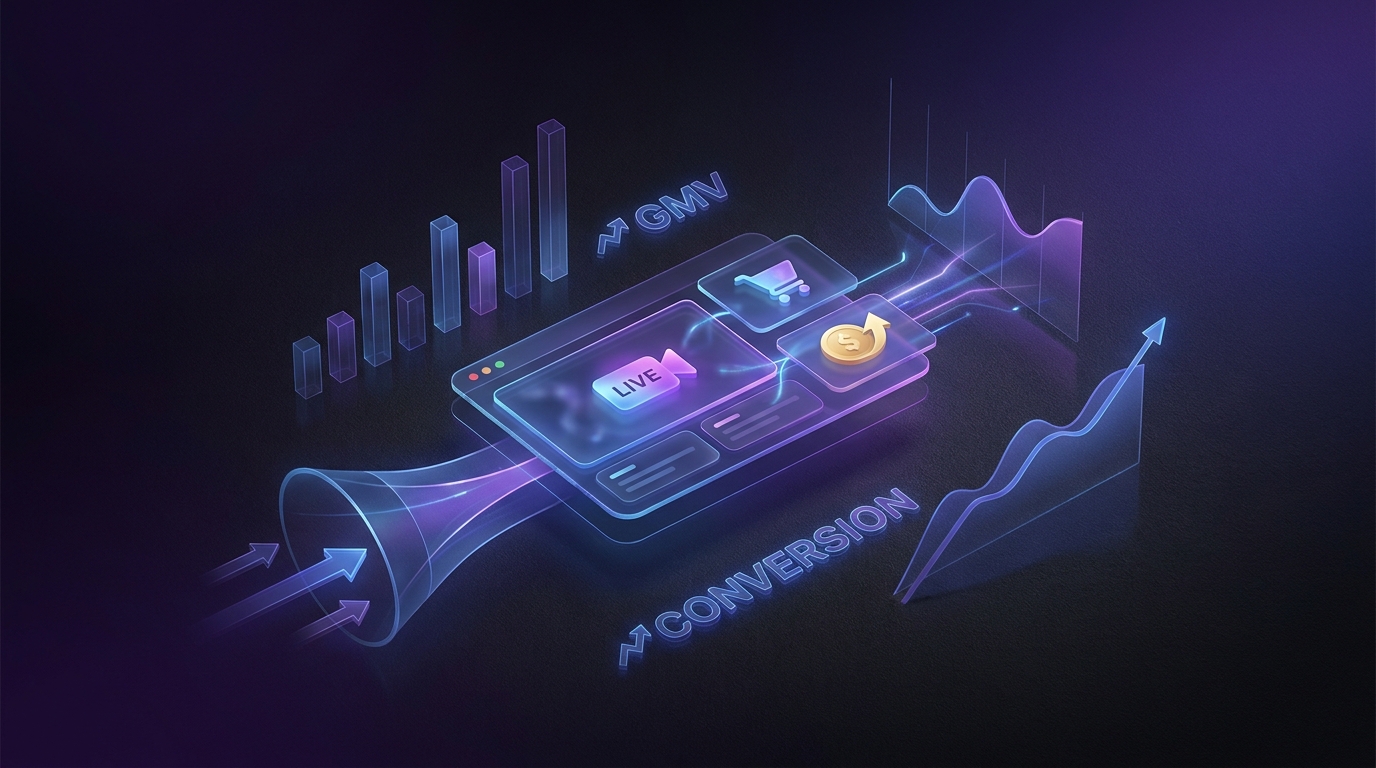
Livestream shopping GMV tactics work because live video compresses the entire purchase funnel into a single real-time experience. Viewers discover, evaluate, and buy without leaving the stream — eliminating the friction points that typically cause drop-off in traditional e-commerce. The psychological levers that drive this compression are urgency, social proof, and perceived exclusivity, and every tactical decision in a high-performing live session reinforces at least one of those three.
"The highest-GMV streams aren't the longest or the loudest — they're the most deliberately paced, with each offer timed to a specific viewer behavior signal."
Understanding how gross merchandise value is actually generated during a stream means looking at three distinct conversion windows: the hook window (the first five minutes when viewers are deciding whether to stay), the momentum window (the middle section where social proof and deal stacking drive purchase clusters), and the urgency window (the final segment where scarcity mechanics and last-chance framing close holdouts). Each window demands a different tactical approach, and the playbook that follows is built around this three-window architecture. If you're looking to build a sustainable program around these principles, a solid livestream shopping strategy gives you the always-on framework this playbook plugs into.
Prerequisites: What You Need Before Going Live
Executing any of the tactics below without these foundations in place will produce inconsistent results at best and a damaged brand reputation at worst. Check every item before scheduling your first optimized session.
| Prerequisite | Why It Matters | Minimum Viable Standard |
|---|---|---|
| Reliable streaming setup | Technical drops kill momentum and erode trust | Stable upload speed of at least 10 Mbps, backup lighting |
| Pre-loaded coupon codes | Coupon drops need to work instantly when announced | Codes tested in your platform's backend 24 hours before stream |
| Inventory visibility | Scarcity claims must be accurate or trust collapses | Real-time stock count displayed or confirmed with warehouse |
| Moderator or co-host | Comment volume during deal windows exceeds solo management | At least one dedicated chat moderator per session |
| Deal run-of-show document | Timing discipline separates top sellers from average ones | Timestamped script with exact deal activation points |
| Warm audience | Cold traffic converts poorly on flash deals | Pre-stream promotion at least 48 hours in advance |
A warm audience is the non-negotiable you cannot manufacture during the session itself. Send push notifications, post teaser content showing the products being revealed, and hint at exclusive-to-stream pricing without revealing the exact discount. This primes viewers to arrive in a buying mindset rather than a browsing one.
Step 1 — Architect Your Flash Deal Sequence
A flash deal is only as powerful as its placement in the stream's narrative arc. Dropping your best offer in the first three minutes burns your conversion ammunition before social proof has accumulated. Saving it for the final minutes misses the viewers who left early. The sequencing approach that consistently outperforms is a three-act deal ladder.
- Open with a value anchor: Reveal the full retail price of your hero product prominently in the first two minutes. This establishes a reference point every subsequent deal is measured against.
- Deliver a teaser deal at minute five: Offer a modest discount (10–15%) with a short expiry. This rewards early viewers, triggers first purchase notifications in the chat, and gives late arrivals social proof that deals are actually activating.
- Build anticipation for the main flash deal: Reference it repeatedly between minutes five and twenty without revealing the discount percentage. Use phrases like "our biggest drop of the night is coming" to hold viewers through the momentum window.
- Activate the hero flash deal at peak concurrent viewership: Monitor your analytics dashboard and drop the main offer when your viewer count is at or near its session peak — typically between minutes twenty and thirty-five for a sixty-minute stream.
- Set a genuine time limit: Flash deals should expire in seven to twelve minutes. Anything longer undermines urgency; anything shorter doesn't give enough time for purchase completion.
- Close with a value-stack deal: After the hero flash deal expires, offer a bundle (covered in Step 4) that maintains momentum without resurrecting the expired discount.
Industry observations from live commerce operators suggest that deal sequences with three or more distinct offers in a sixty-minute stream consistently outperform single-offer sessions on per-viewer revenue, even when the total discount value is identical.
Step 2 — Deploy Coupon Drops at Peak Engagement Windows
Coupon drops are one of the most reliable in-stream GMV tactics because they require viewer action — typing a code, clicking a pin, or following a link — which itself increases psychological commitment. The mechanics of a well-executed coupon drop are as follows.
- Pin the coupon to the chat immediately upon announcement: Don't rely on viewers scrolling back through a fast-moving comment feed. Pin it so it remains visible throughout the activation window.
- Tie coupon release to a viewer action: "Drop a fire emoji in the chat and I'll release the code" spikes engagement metrics simultaneously, which can trigger algorithmic amplification on platforms like TikTok. For a deep dive on this mechanism, see the full TikTok Live shopping strategy guide.
- Stagger multiple coupons across the session: Rather than one large discount code, use two or three smaller-value codes at different timestamps. This trains viewers to stay watching because they believe another code is always coming.
- Set expiry windows, not expiry quantities: Quantity-limited coupons (first 50 claims) feel arbitrary to viewers who miss them. Time-limited coupons (expires in 8 minutes) feel fair and maintain urgency without alienating late claimers.
- Announce the next coupon drop time before the current one expires: "This code expires in three minutes, and at the top of the hour we're dropping something even bigger" prevents post-deal viewer drop-off.
"Coupon drops that require viewer participation — even a single emoji — consistently outperform passive code reveals on both redemption rate and post-session follow metrics."
Step 3 — Activate Scarcity and Countdown Mechanics
Scarcity is the most powerful conversion lever in live commerce, but only when it's real. Fabricated scarcity claims destroy trust the moment a viewer checks back the next day and finds the same product at the same price with identical availability. Authentic scarcity mechanics, by contrast, create genuine urgency that holds up to scrutiny.
- Display live inventory counts on screen: Use your streaming software or platform tools to show a real unit count that decrements as purchases are made. Watching a number drop from 47 to 31 in real time is more persuasive than any verbal claim.
- Use countdown timers for both deals and shipping cutoffs: "Order in the next nine minutes for same-week dispatch" combines price urgency with logistical urgency, doubling the pressure to act.
- Leverage social proof signals as scarcity amplifiers: When a purchase notification appears in stream ("Sarah from Austin just ordered 2"), follow it with a stock reference: "That brings us down to 23 units left." This chains social proof directly to scarcity.
- Reserve a small batch of units specifically for stream-exclusive pricing: If you have 500 units in stock, allocate 80 to the stream at the flash price. When those 80 sell, the deal genuinely expires even though product remains available at full price. This is honest scarcity that holds up to scrutiny.
- Verbalize the countdown as it winds down: "Twelve units left… ten… eight" creates an auction-style atmosphere that dramatically compresses decision time for hesitant viewers.
Step 4 — Structure Bundle Offers for Maximum Cart Value
Flash deals maximize conversion rate; bundle offers maximize average order value. The two work in tandem — use flash deals to get buyers into the checkout funnel, then use bundles to increase what they're spending once they're there. The bundle structures that produce the strongest GMV lift share a common design principle: they make the individual item purchase feel like the inferior choice.
- Price the bundle so the per-unit cost beats the flash deal price: If your hero item is flashing at $35, a two-item bundle at $58 ($29 each) makes the single-unit purchase feel wasteful for buyers already committed to buying one.
- Introduce the bundle after the single-item flash deal has established momentum: Let the chat fill with purchase confirmations from single-item buyers, then reveal the bundle as an upgrade. The social proof from first-wave buyers validates the product, lowering the perceived risk for the higher spend.
- Use complementary product pairing, not random bundling: Bundle products that solve the same problem or serve the same use case. Viewers immediately understand the value of a skincare cleanser bundled with a toner; they do not immediately understand a toner bundled with a phone case.
- Name the bundle something memorable: "The Reset Kit" or "The Starter Pack" gives buyers something to reference in the chat and makes the offer feel curated rather than discounted-inventory clearance.
- Create a bundle-exclusive gift with purchase: Adding a low-cost, high-perceived-value item (a branded pouch, a travel-size product, a digital download) exclusively to the bundle drives upsell without requiring additional discount depth.
Step 5 — Use In-Stream Persuasion Loops to Sustain Momentum
A persuasion loop is a repeating narrative structure that keeps non-buyers engaged while reinforcing purchase decisions for those who already bought. Without deliberate loops built into the script, streams tend to plateau after the hero deal and bleed viewers through the back half of the session.
- Run a recurring "reason to stay" announcement every five to seven minutes: Alternate between teasing the next deal, acknowledging recent buyers by name (or username), and sharing a product demonstration or testimonial. This creates a rhythm that viewers acclimate to.
- Use the FOMO bridge: After each deal closes, briefly describe what buyers just secured before moving on. "Everyone who grabbed the Reset Kit is going to love what's coming next" rewards buyers and makes non-buyers feel they're falling behind.
- Invite real-time testimonials from chat: Ask viewers who've previously bought the product to share their experience in the comments. Pinning one authentic testimonial per deal window provides third-party validation that no scripted claim can replicate.
- Bookend each deal window with a clear call to action: Open every deal segment with the action ("Click the link in bio / tap the cart icon / drop your size in the comments") and close it with a summary of what was just offered and what's coming next.
- Monitor and respond to purchase hesitation signals in chat: Comments like "Is the quality worth it?" or "Does it run small?" are public objections. Addressing them on-stream — directly and specifically — converts hesitant viewers in real time and demonstrates confidence in the product.
Common Mistakes That Kill In-Stream Conversion
Even sellers with strong products and engaged audiences leave significant GMV on the table by making the following avoidable errors. Eliminating these from your sessions will have a measurable impact on per-session revenue within two to three streams.
- Starting deals too early: Dropping your hero discount before viewer count has stabilized means fewer people see it and the social proof cascade never builds. Patience in deal timing is one of the most undervalued skills in live commerce.
- Letting deal windows run too long: A flash deal that stays active for twenty-five minutes isn't a flash deal — it's a sale. Urgency requires genuine time pressure. Extended windows teach viewers to wait rather than act.
- Ignoring the chat during deal windows: This is the highest-engagement moment in the stream. Going silent on the chat while viewers flood it with questions destroys conversion. Have your moderator handle basic questions and surface objections to you in real time.
- Offering too many deal types simultaneously: Running a flash deal, a coupon drop, and a bundle offer at the same time creates decision paralysis. Serialize your offers; don't stack them on top of each other.
- Failing to promote the stream in advance: Many practitioners report that streams with 48-hour pre-promotion generate meaningfully higher peak concurrent viewership than surprise or same-day streams, all else being equal. A warm audience is built before you go live, not during.
- Using fake scarcity: If a product is back in stock at the same price two hours after your "last 10 units" warning, returning viewers notice. The credibility damage to future streams far exceeds the short-term conversion gain.
Expected Results and Timeline
Implementing the full playbook — deal sequencing, coupon drops, authentic scarcity, bundle structuring, and persuasion loops — is not a one-session transformation. Here is a realistic progression based on what live commerce operators typically report when applying these tactics systematically.
| Session Range | Primary Focus | Expected Outcome |
|---|---|---|
| Sessions 1–3 | Deal sequencing and coupon mechanics | Baseline GMV established; conversion rate data becomes meaningful |
| Sessions 4–6 | Scarcity timing and bundle introduction | Average order value begins to climb; repeat viewer rate increases |
| Sessions 7–10 | Persuasion loop refinement and audience warm-up optimization | Peak concurrent viewership stabilizes; GMV per viewer improves noticeably |
| Sessions 11+ | Full system execution with format experimentation | Compounding audience loyalty; predictable GMV bands per session |
The sharpest GMV gains typically appear in sessions four through seven, once the mechanics are familiar enough to execute confidently and the audience has been conditioned to expect deal windows. Sellers who treat each stream as a data collection exercise — reviewing peak viewership timestamps, deal redemption rates, and bundle uptake — compound improvements faster than those who simply repeat the same format without iteration.
Frequently Asked Questions
How long should a flash deal last during a livestream shopping session?
Flash deals perform best when they run for seven to twelve minutes. This window is long enough for viewers to complete the purchase flow — including any hesitation, size selection, or payment entry — but short enough to maintain genuine urgency throughout. Deals running longer than fifteen minutes lose their time-pressure effect and viewers learn to treat them as ordinary pricing.
What is the best time to drop a coupon code during a livestream?
The highest-performing coupon drops occur during natural engagement peaks: shortly after a product demonstration lands well, immediately following a cluster of purchase notifications in chat, or when viewer count is at or near its session high. Avoid dropping codes in the first two minutes (before social proof has accumulated) or in the final three minutes (not enough time for redemption). Tying the drop to a viewer engagement trigger — like a comment prompt — amplifies both redemption and algorithmic reach simultaneously.
How do I use scarcity in livestream shopping without being dishonest?
Authentic scarcity means allocating a specific, limited quantity of units to stream-exclusive pricing and genuinely ending the deal when those units are claimed — even if more inventory exists at full price. Display real-time inventory counts sourced from your actual stock management system, and never verbally claim scarcity you cannot substantiate. Viewers who feel misled become vocal critics; viewers who experience genuine scarcity become loyal attendees who arrive early to future streams.
How many deals should I run in a one-hour livestream?
A sixty-minute stream typically supports three to five distinct deal moments without creating offer fatigue. A standard structure is a teaser deal (minutes three to eight), the hero flash deal (minutes twenty to thirty-five), a bundle offer (minutes thirty-five to fifty), and an optional closing deal or shipping incentive in the final ten minutes. Running more than five separate offers in an hour tends to fragment attention and reduce the perceived value of each individual promotion.
What metrics should I track to measure livestream shopping GMV performance?
The five metrics that matter most are: peak concurrent viewership (the ceiling for any given deal's reach), deal redemption rate (conversions divided by viewers present during the deal window), average order value per session (to measure bundle effectiveness), viewer-to-buyer conversion rate (total buyers divided by total unique viewers), and repeat buyer rate across sessions (the strongest signal of audience loyalty and sustainable GMV growth). Tracking these session-over-session reveals which tactics are compounding and which need iteration.